
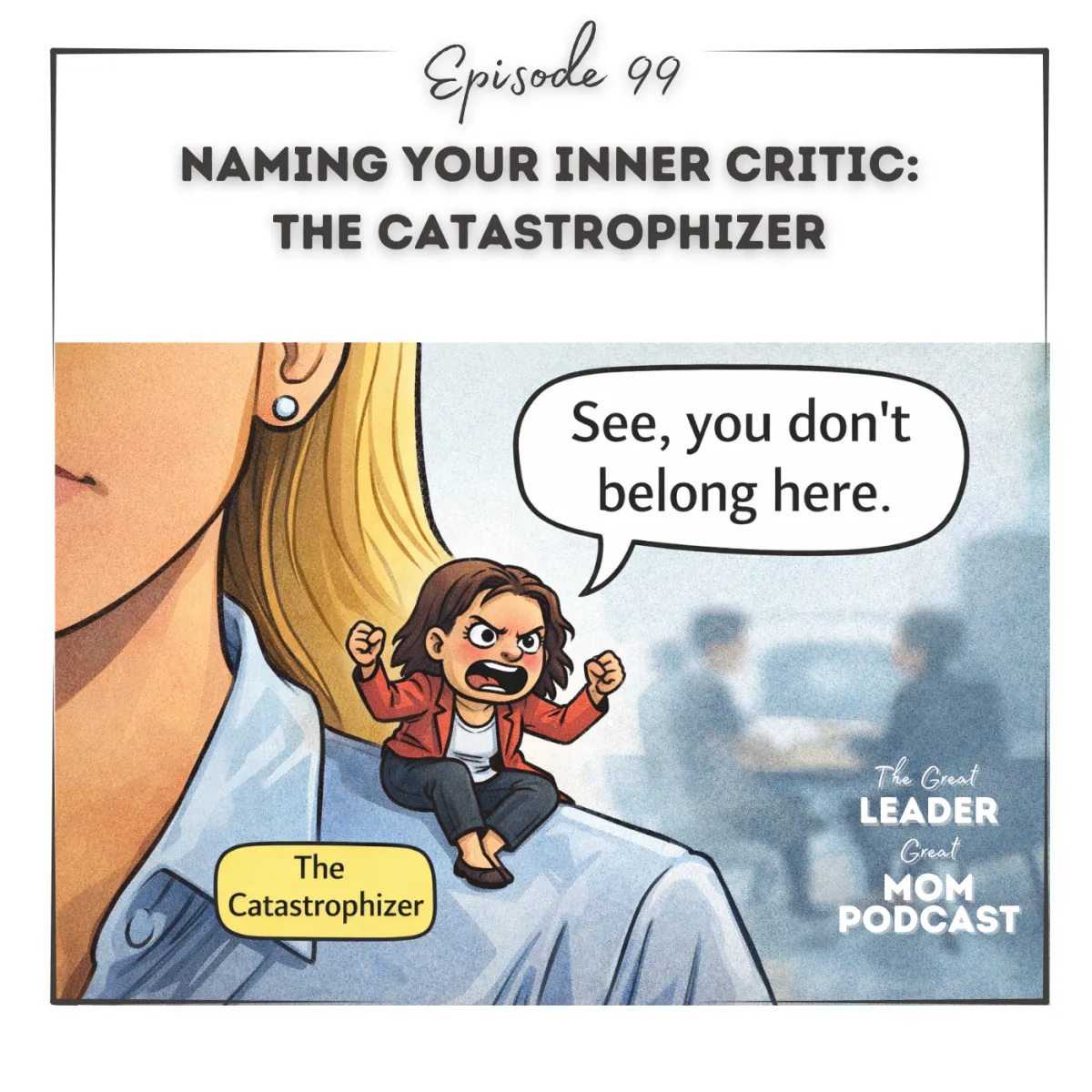
99 Naming your Inner Critic The Castastrophizer
Unpacks The Catastrophizer—the inner critic voice that turns one meeting correction into feeling like a fraud, and how to create space.
View Full Episode Transcript
Welcome to the Great Leader Great Mom podcast, where we trade in mom guilt and burnout for courage, calm, and a whole lot more joy. I'm your host, Liz Jolly, Life Coach, Mama 3 and founder of the School of Courage. We're starting a series about If your inner critic had a job title, what would it be? We're gonna dive in today to one I call the catastrophizer, where we turn one moment into a career obituary So this should be fun. Glad you're here. This is episode 99. How many of you have ever had a moment in a meeting or in the hallway? that your brain turned into a full-blown crisis. Like you said something, maybe someone corrected you, or you were in a presentation and they asked you a really tough question. And maybe their tone wasn't even that harsh, or maybe it could have been condescending. Maybe they were just straight up rude, which could have made it worse, but suddenly, without even realizing it, you took their words And made it mean I don't belong here. They think I don't know what I'm talking about. I'm a fraud. I'm never gonna get that next role. Nobody values what I have here It happens so fast in our brain, like in a millisecond. And that's what I want to talk to you about today because I think so many of us, we know the feeling that we're sitting in a room, we're trying to contribute, we're bringing our presentation, we're bringing our ideas, we're trying to lead. And then one small moment, like a person says words. And our brain interprets it as proof that we were never supposed to be here in the first place. And that voice in your head, today, I'm gonna call her the catastrophizer. Now there's a real power in naming these moments because it can make you kind of laugh a little bit. It creates space between what's happening around you and how you react. including the emotions you feel, what you're thinking, the actions you take or don't take, and how you are literally present in the room. And so if we dig into who the catastrophizer is in these moments, she's dramatic, she's loud, she's deeply committed to turning one uncomfortable moment into a total career disaster. And I say that a little playful on purpose because part of the power here is being able to see what's on your mind and instead of becoming it, more just observe it. And that is the whole point of this episode and how I'm being playful with calling her the catastrophizer. When you can name that voice in your head, it's almost like when you see the little devil and the little angel sitting next to you telling you on opposite sides what's to do. That is the same kind of thing here. You can chuckle because you can imagine this little character you call the catastrophizer sitting on your shoulder. And it creates that separation, that space for you to maybe chuckle a little bit, and now you're in observer mode. And once you're in observer mode, you're no longer hooked by the catastrophizer voice in your head That's when all your power comes back in that meeting. That's how you stay your grounded self. So let's go with a specific example. Say you're sitting in a meeting, you shared a thought Maybe it's a recommendation, maybe it's an idea, maybe it's just your opinion on something. And then somebody next to you jumps in and says, actually, I think it's more like this. And in that moment, your brain doesn't make it mean, oh, we're just discussing ideas here. Let's keep on bantering until we come up with something great. No, your brain makes it mean they don't think I belong here And that's when you're hooked. That's when everything just happens in your body where you want to shut down, you feel inadequate, you feel embarrassed, you feel small. And then from that feeling, you start changing who you are in that room. You've stopped asking questions, you've stopped contributing, you're pulling back. Maybe you literally want to just like crawl under the table You don't stand up for yourself. You don't pull on that place within you that could say, tell me more, or let's really build on this. You basically disappear while physically sitting there, but not contributing any longer. And what's so painful is that by the end of this meeting, it can feel as though you've literally proved it true. When you think they don't think I belong here, you've started to No longer contribute, no longer really be present in the room, no longer be your best self. You've made it where you don't belong there. Like what's your purpose if you're just gonna withdraw? And I say that harshly so we can see ourselves and how thinking that thought does not serve us at all and the importance of questioning it. and examining it and seeing what it creates for us. At the end of that meeting, a lot of us would say, see, I didn't even belong there. Nobody asked me a question. Nobody even looked at me. But that's not what actually happened. What actually happened is that someone said words and you made it mean you didn't belong. And from that thought, you felt rejected. And when you were feeling rejected You disengaged from the whole meeting. You created the truth that you shouldn't belong there. And that's the part I want all of us to see, the power we have to create our presence in the room. We think it's just like the way it is, but the reality is it's not. We have a moment to choose when someone says words, how we respond, how we stay present, how we contribute in the room And that's the power I want all of you to have in every room so you can be your grounded self. The problem isn't the words they said, that they corrected you, or the tone in which they said it, or that everybody agreed with them That is not it. The problem is what your mind made it mean. It created a whole identity around this story your brain offered on default. And listen, I really want to say this with compassion because I've been there. And I don't think that women do this because you're weak or you are broken in some way. We've been conditioned to believe that we need to be incredibly polished, to be perfect, to be prepared in every single way to know all the answers. to be perfectly in order, to earn the place, to take up space at the table, to sit at the table, to contribute at the table. A lot of women have learned somewhere along the way that perfectionism is the price of belonging. So if you're corrected, if you're challenged, if you're misunderstood It doesn't just feel uncomfortable, it feels like you're threatened. It feels like you've lost your permission slip to be at the table, to take up space. And that's why these moments can feel so real, so hard But when I think about the most grounded, powerful leaders I've ever been around in a room, they are not powerful because no one ever questions them. They're powerful because they stay with themselves when it happens. They don't react. They don't let one moment or one set of words cause them to totally collapse or to freak out or get defensive. They don't immediately decide that the room is turned against them. They don't hand the whole meeting over to the inner critic, the catastrophizer. They stay grounded, and that's the difference in their thinking. So what I want to offer you today is a way back to your grounded self when the catastrophizer takes over your brain. The first thing is to take advantage of the emotional window. When you feel the hairs on the back of your neck stand up or your body Reacting and shutting down, that is a feeling. That's the vibration within you. The feeling is created. Notice it. Your body usually knows before your brain catches up. It could be your chest is tightening, maybe your stomach drops, maybe your face gets hot, maybe there's just this rush of inadequacy that moves through you, and it literally is a visceral response. That feeling is so important. That is the window in. And a lot of times we move so quickly into reacting that we don't have enough space in that moment to realize what's happening. Our feelings are an incredible flag for us to show us that something's happening. We've been hooked. And I want to ask you, what's in that moment, if you can catch the feeling, slow down and say, why do I feel this way right now? Because your brain is going to offer you a sentence that's creating the spiral. And you can write down as many sentences that come up. And it can be something like, they think I'm incompetent, I don't belong here, I'm a fraud. They've ruined my credibility. I don't know anything. I shouldn't even be here. That's when we're examining all the hooks that are triggering us. And once we identify just one sentence, it doesn't take more than that, you can stop living inside of that sentence unconsciously Because now you have something to work with. So this is where we move into auditing our sentence and see what it does for us in that moment, how it's serving us. We slow down long enough and we get honest. Okay, when I'm thinking that I don't belong, what does that make me feel? And a lot of times then we can say, well, I feel rejected. And so you can ask yourself, when I feel rejected, how do I show up in that room, in that chair? What am I doing? What am I not doing? And you can identify the fact that you're not contributing, you're shutting down You're disengaged, your brain is ruminating on all the reasons why you don't belong. That's you creating the result of you don't belong there because you've lost yourself in that moment. That's the catastrophizer taking over your brain and letting that unhelpful thought, that unhelpful sentence take root within there. And it doesn't need to be there. Think of that strong leader who Is your example and maybe they sit there and they get those questions and they think, oh, this is great. Tell me more. Let's dig in. And you build on that idea. That would be you showing up as your highest self. But when we're on default and we don't question the sentence in our brain, we just obey it. We just shut down. We think I've feel terrible right now because of the words they said. And that is optional. That's you giving your power away and you don't have to. You can remember this. The sentence is just a sentence your brain made up It's not the truth. It doesn't mean that you truly don't belong in the meeting or whatever your thought is. From that moment, you can create a conscious shift. And this is where I want women to really feel your power. Because the shift is not pretending the moment didn't sting or trying to fake it. The shift is not forcing yourself to be upbeat. It's asking, who do I want to be here in this moment? Noticing the catastrophizer telling you this terrible story and realizing like not today, catastrophizer. I can handle being corrected. This doesn't mean I don't belong. I do belong here. Look at me. I am know that is true because I am here at the table in the chair contributing I'm still credible. I can ask more questions. I don't need perfection to take up space. Or something even greater would be to really innovate and come up with the best idea. It has to be a team effort This is where we take an idea and we make it even more curated and even more to the next level. You can also think things like, I didn't want to belong to myself here I love that one because the opposite of the spiral is not perfection. It's belonging to you. It's staying connected to yourself even when the whole room feels uncomfortable and maybe they really are trying to reject your idea or they're trying to insult you based on their tone, it doesn't matter Don't you want to be the woman who stays grounded no matter what? In that moment, if you can create enough space, you can say, say more about your point. I want to hear and understand it better. And you can take a deep breath and you can shut down the catastrophizer and not get hooked by her I care so much about teaching women this because if we can all create space in those tense moments between the circumstance and our reaction That's where we have our choices. That's where we have all our power. And that's where you become your grounded self. Not by controlling the room, not by being perfect. Not by being the smartest person in the room or never getting corrected, but to be able to stay with yourself in the moment when that inner critic, the catastrophizer, wants to run the show. So next time this happens, because it will, you're a human and you work with other humans who all want to do great work. You're all very smart and very capable. I want you to notice the feeling. I want you to notice the catastrophizer. And I want you to use that as your window in and say, why am I shutting down in this moment? Identify the sentence. And see how it creates your result of maybe shutting down in the moment or getting defensive. And realize I'm giving all my power away. And I can create the result I really want here, which is to be grounded and courageous and assured, no matter what they say or the words that come out of their mouth. Because now you're awake. Now you're observing. Now you're leading yourself. And that's what I want all women at work to experience. I want you to be so grounded in that meeting room that one comment doesn't define your identity. You don't get hooked by it You don't even notice it. You just keep digging in and asking more questions. I want you to know how to come back to yourself if you do get hooked. You can do this. I if I can do it, you can totally do it. And it starts with recognizing that voice, the catastrophizer in your head is not you. It's just a sentence that's she's creating and you can question it and examine it and lay down her words and step over them I want you to smile a little bit when you hear her and you can say, catastrophizer, I see you, and this is not even the truth. So thanks for trying to keep me safe, but not today. Don't dismiss yourself in those moments. You can use that moment to create more space between what's happening and how you respond. Because that space is everything. That's a space where you come back to yourself. That's a space where you remember to choose how you want to show up. The space is where your grounded leadership, your ideal, courageous woman shows up in the room. And that's what I want for every single one of you. If this episode resonates with you, share it with someone who needs to hear it as well. If you want actual support to become your grounded self, go to lizjolly. com and check out the School of Courage membership where we do this every single week. You get to do the in-depth work to find more space in your life to no longer react, to no longer feel overwhelmed or burned out. And to create the result you want in your life. That shift is what we all deeply desire. And I want all women to find their grounded self. I'll see you next week, everybody, where we dig in more to all the critics in our brain. Take care, everyone.
