
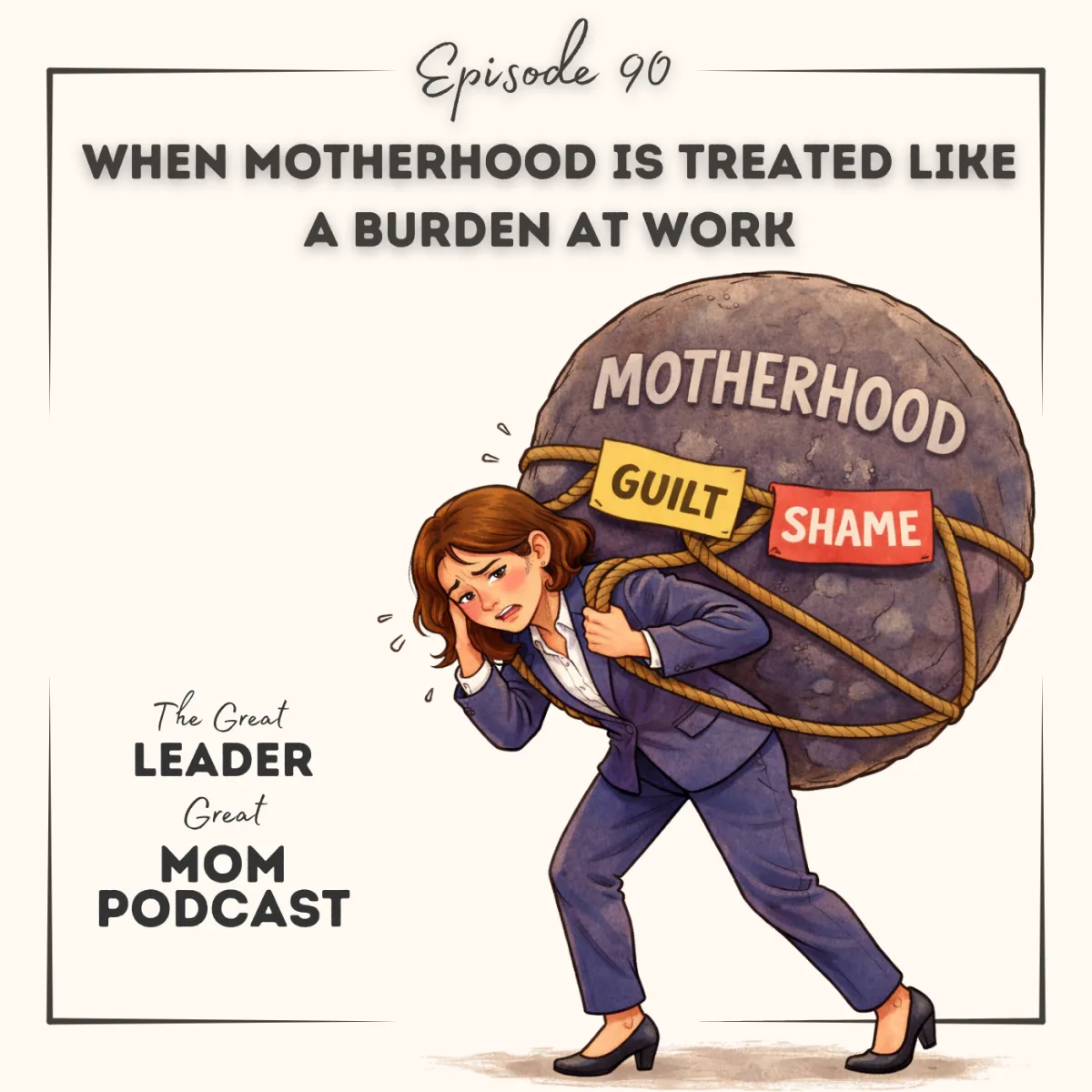
90 When Motherhood Is Treated Like a Burden at Work — And How to Stop Carrying the Shame
Discusses what happens when motherhood is treated like a burden at work and how to stop internalizing systemic bias as personal failure.
View Full Episode Transcript
Welcome to the Great Leader, Great Mom podcast, where we trade in mom guilt and burnout for courage, calm, and a whole lot more joy. I'm your host, Liz Jolly, engineer turn life coach, mom of three, and founder of the School of Courage. Here we talk about leading at work and at home. Without losing your sanity, your sense of humor, or yourself. If you're ready to drop the guilt and grow your courage, you're in the right place. To kick off 2026, I put together something very special for you. It's a curated list of my favorite podcast and videos on leadership and culture. These are resources I have come back to over and over again. Every time I watch them, I take away something new. You can grab it for free at lizjolly. com forward slash leadership-culture or by tapping the link in the show notes. Well, this is episode 90, and we are gonna talk about when motherhood is treated like a liability at work. I know many moms experience something like this, but we don't normally talk about it. It's this moment when your phone rings during the workday and you already know. it's the school or it's when your kids wake up sick and your first thought isn't concern, it's panic. And I know you care and of course we care about our child But what's going on in our mind is we're calculating how bad is this gonna look at work? What is my boss gonna think? How much goodwill am I burning? How do I make sure no one thinks I'm that mom that doesn't care about work So if you've ever felt like your life outside of work is being silently audited, this episode is for you. Because somewhere along the way, many women learn this message that motherhood makes you a liability at work. And today we're gonna gently but clearly take that belief apart. So let's name what's happening without villainizing anyone. There's often an unspoken equation operating at work in so many corporations across the world. Reliability equals availability. Commitment equals uninterrupted focus. And time in your chair. Professionalism equals minimum personal needs. And motherhood breaks that illusion. And this isn't because moms are not committed to work, it's because caregiving makes humanity so visible. This is life This is the window in that we saw during COVID when people started to have compassion for others because you would see them with their kids showing up on the screen, right? Kids really do get sick Schools call, things happen, life interrupts, and instead of questioning the system, so many of us question ourselves. And we think, I need to prove that I'm serious, or I should apologize more, or maybe I should just not even ask and pretend this never happened and hope that they don't see me not being here first thing at 8 a. m. I should make up for this somehow. You're not doing something wrong here. It's the system that's designed around an outdated idea of the ideal worker. And this out-of-date system has Where a wife stays at home or a grandma's living in the household to help, or there's neighbors all around that do everything together to help each other out. like carpooling when their kids do the same activities. And this just isn't really common anymore. Now we have dual working couples. We have family that's so far away and doesn't even live in the same state We have neighbors that are super nice maybe, but their kids do totally different activities all over the city and somewhere maybe not near you. So this system is out of date that we live in. And I'm not saying we're gonna change corporate America, but I think we need to acknowledge what's real. And here's another thing that's so important to understand Working moms are not guilty of being unreliable. They're guilty of believing the story about what reliability means. And let's separate these two things. The facts are you may have left early to pick up your sick child, or you took a call from school in the office, or you adjusted your work schedule. But the stories we make up about this are I left early and that makes me less dependable, or they're annoyed at me, or I'm a burden, I'm a problem to the people around me or my boss. The facts are neutral. The stories are loaded. These are the things that we made up about it. And when you blend these two together, guilt rushes in. We think we should be different. We think we should have been here all day with no interruptions. That life shouldn't have happened. And so we start over-explaining, we start over-apologizing, we over-perform to earn our way back in someone's eyes of that approval. You want to feel like you're good enough. You want them to see how dedicated you are. You want them to tell you it's okay that you left and took care of your life. Or something that gets rid of this guilt inside to make us feel good. And this part is subtle but powerful. When you're constantly apologizing for being a mom, you unintentionally reinforce the idea that your needs are a disruption that you're telling yourself this is not all okay and then you feel terrible and you better go get their approval to make yourself feel better. And it can sound like I'm so sorry, I'll make this up later, or I hate to ask, but I know this is inconvenient, and over time this trains you and others to see your humanity as something that needs justification, as a problem. Confidence doesn't come from pretending nothing is happening or covering it up or hiding it. It comes from clean ownership without self-punishment. It's really simple, and I know it feels so uncomfortable, but the more we own it, the more we're courageous, and the more we just accept the fact that Yeah, I'm a human and I have a family and I choose to take care of them. So here's the reframe. You don't need to convince anybody that you're committed to your work. You need to commit to yourself first, to wanting to pick up your child if they say have a tummy problem at school. You want to be there for them when they need you. Seriously, think about this choice. You probably don't have to. You want to. Stop telling yourself that you have to because so much of that leads to guilt and resentment. Here's what this looks like. It's stating what's happening without emotional charge. It's communicating the plan instead of apologizing for the problem. Letting your results, your performance speak louder than your guilt. So for example, instead of I'm so sorry, I know this isn't ideal, I'll try to log back on later, you hear the apologizing, right? The preamble the this is a problem, I'm gonna try to fix it. Where it's not from a place of confidence. Instead you might say, I need to step away to handle a family member. Here's how I'm gonna ensure we're coverage and here's how I am getting all my things done It's the same reality and it's not coming from the emotion of hustle or trying to prove. It's coming from a place of confidence and love and acceptance for who you are and what you're choosing to do in your life. It's a completely different energy because these words really do come from a different feeling. One is asking for forgiveness, one is demonstrating leadership and self-confidence and self-love. So let's zoom out. A good employee is not someone with no personal life That would be potentially good to be a robot, which corporations may want in fifty years, but for now they get us humans. And a good leader is not someone who never needs flexibility. A good employee delivers results. They communicate clearly. They collaborate effectively. They take responsibility. They get what needs to be done. Done on time and on budget. They think long term. None of those disappear when you become a parent and you have a thousand more balls to juggle, but you still have those skills. Actually, I would argue a lot of times when you're juggling things at home, you're better at juggling things at work because you've honed in on this skill. I had a client tell me one day, I'm not as good at my job because I have this burden on top of being a mom. And I challenged that and said, whoa, whoa, whoa. What if the opposite is true? That you're good at your job because you do everything at the house. I asked her what does she believe about herself as a mom and a leader? And she said, I love organizing, I love being the ones the kids come to, I can handle it. I'm a fixer at work and at home. And I said, those things are true at work, in at home. And I bet you You're better at work because of how you're so good at home. The skills cross over. It's all these lessons that we learned, and your brain is able to apply this everywhere Think about instead what is this teaching you that applies to the work side or the home side? I guarantee when you think you're burdened on one side because of the other, you're seeing it all wrong. We need to see the world from a standpoint of that this skill set hones me to be even better at work because it's true. The more you start to believe that, you will see how true it is. The proof is there We need to drop this internalized belief that motherhood is a burden for work instead of it's kind of a superpower Because of your ability to get things done, your ability to organize, to deliver with very little time. I'm telling you, have you guys ever seen a mom while their kid is napping for an hour What they can get done, it's phenomenal. She can shower, clean the house, do the dishes, do the laundry by the time the kid wakes up. And answer a bunch of emails and probably finish a presentation or two. It really is amazing what women can get done and dads too after you have kids and you realize how effective you are if you put your mind to it. If you take nothing else from this episode, take this in. You are not a burden. Stop seeing yourself as a burden because you have kids. And if people see you as a burden, that is definitely on them. You are not unreliable. Be reliable to yourself first. You're not unprofessional for being a human. Remember, you don't want to be a robot. I mean, really. Although I do love Wild Robot, but if you think about what makes her so magical is her humanness. Nobody wants to work for a leader who's a robot and has no humanity around them. And we don't want a team to work with that is full of robots. That what connects us is our humanity. Motherhood doesn't make you less capable. It makes you more real. And your work isn't to harden or hide or overprove who you are and what you care about with your life It's to lead yourself with enough self-trust that there's no more guilt running through your brain or even into your conversation with yourself In the next episode, we're gonna talk about something related and often more complicated. What happens when your boss is a woman without kids and how it feels harder, not easier, to be under her. If you like what you're hearing and you want to practice this and see the growth in your life even more, check out my School of Courage membership. This is where we meet weekly and we dig into hard topics so that you can grow your confidence, feel more present in your life. And February is so exciting. We are going to talk about your future self So often women aren't allowed the space to imagine what they could be doing in three years. Who could they be? What is the impact they want to make on the world? As women, I think so often we grow up being told what to do, what we should do, what we're capable of, and we squelch down this voice inside of us that desires more, that wants to make an impact on the world. February is all about unraveling that desire within you and finding who is your future self that you want to be and how do you live into that. If you want to learn more, go to lizjolly. com forward slash membership and check it out. There's also a link in the notes. See you next week, everybody.
