
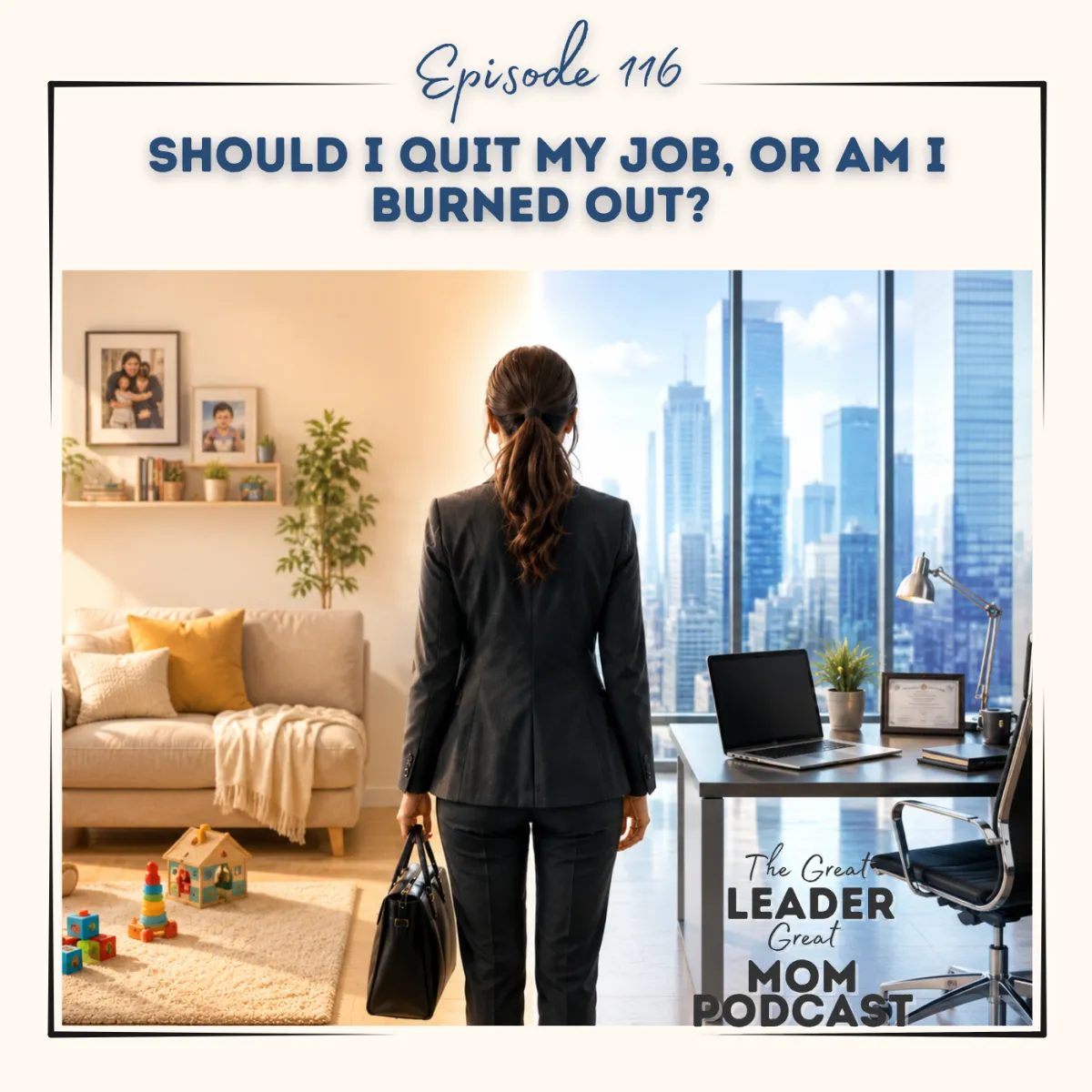
116: Should I Quit My Job, or Am I Burned Out?
Should you quit your job—or are you burned out and desperate for relief? Learn how to separate a genuine desire for career change from the hope that leaving will finally make you feel worthy, successful, or good enough.
View Full Episode Transcript
How to Know Before You Leave
[00:04] Should I quit my job, or am I just burned out? That’s what we’re exploring today. Welcome to The Great Leader, Great Mom Podcast. I’m Liz Jolley—engineer turned life coach, mom of three, and founder of The School of Courage.
The Life Your Brain Imagines When Work Feels Like Too Much
[00:18] Okay, friend. Picture this with me. You’re sitting in a meeting that is going absolutely nowhere. Everything could have been covered in an email, yet here you all are, sitting around a table while someone talks over you and asks questions that prolong the meeting even more.
[00:34] You stare at the clock and think, It’s almost time for my child’s pickup—and you already know you won’t be the one picking them up today.
[00:44] Your brain begins to panic. Then it pictures a completely different life: no meeting, no rushing, and dinner actually prepared by the time the kids get home.
[00:53] Your house feels comfortable, organized, light, and airy instead of like a disaster zone. For a moment, your shoulders drop while you sit in that meeting, and you remember to breathe. It feels so good.
Relief Is Real—but It Is Not Proof
[01:09] There is something sneaky our brains do in these moments, and I don’t want us to miss it. The relief we feel when we visit that little fairy tale or dreamland is real. That relief matters, and I’m not telling you to ignore it.
[01:24] But relief is not evidence that you should make the decision you are imagining.
[01:33] You assume you feel better because you pictured a different circumstance: no job, more time at home, more time for yourself, cleaner counters, and no dishes stacked in the sink.
[01:45] But the relief isn’t appearing because you actually quit. It is appearing because your brain shifted and made the imagined life mean something different.
[01:52] For many of us, the story is: If I quit my job and had more time to be home, make dinner, or keep the house organized, then I would be a good mom.
[02:03] Or we think: If I had extra time and could work out, I would finally feel better about myself.
[02:10] We tell ourselves: That is when I’ll finally be doing things right. I’ll be organized. I’ll stop disappointing everyone. I’ll take care of myself again, and I will finally be enough.
[02:24] That is very different from saying, “I want a different job,” or, “I don’t want a job at all.” I want you to be honest with yourself about which desire is actually running the show in your brain.
The Rodeo Day I Missed
[02:32] Here is a story from a handful of years ago. My daughter was in first grade, and her school was having Rodeo Day. She went all in. She came downstairs wearing the cowgirl hat, the boots, and the entire outfit.
[02:46] She looked amazing. I genuinely thought she was simply excited to dress like a cowgirl and have fun that day.
[02:47] What I had not registered was that Rodeo Day included two hours of parent involvement on a Thursday at 9:00 a.m.
[03:04] For those of you who work, that is right in the middle of core working hours—Thursday from 9:00 to 11:00 a.m.—when many people in corporate jobs have nonstop meetings. I worked an hour away, so I had not even considered attending a possibility.
[03:27] When I arrived to pick her up, she came to the car looking devastated. She looked me in the eye and said, very dramatically, “Mom, I was the only one without a parent at the thing.” Then she burst into tears.
[03:41] It broke my heart. My brain immediately began beating me up and saying, “A good mom would have been there.”
[03:51] I allowed that thought to take root. Then I created a fantasy: See? If I didn’t have this job, I could live a life in which I was a good mom. I would never have to say, “I can’t make it.” I would always be there.
[04:07] But here is what I eventually learned: I wasn’t only imagining a new schedule in which I could attend every parent-involvement opportunity.
[04:10] I was imagining finally being good enough to be a good mom and finally doing everything right. That is why the fantasy felt so good.
[04:22] The relief had nothing to do with whether I had a job. It came from my belief system and what I made the imagined change mean.
[04:31] The relief I felt was real, but it wasn’t caused by the job or the idea of leaving it. It came from the story I created about what quitting would prove.
Her Disappointment Did Not Make Me a Bad Mom
[04:41] If I had paused long enough to question that belief system, I could have asked: Do only good parents attend every parent-involvement event? Does missing one event make someone a bad parent, regardless of everything else they do for their child? Those questions reveal how unreasonable the story was.
[05:03] There was another important piece: My daughter’s disappointment made me think I was terrible. I was disappointed in myself, and I was determined to soothe her disappointment so that she would never have to feel it—just as so many parents try to do.
[05:22] But disappointment is part of the 50/50 experience of life. As humans, we will have moments when we feel disappointed, sad, frustrated, or disappointed in ourselves and other people.
Your Brain Comes With You
[05:40] The challenge is that no matter what decision we make, our brains come with us. This matters because you may genuinely decide to leave your job or change something else in your life.
[05:54] But don’t make the decision based on the hope that you will automatically feel better on the other side—or that only then will you finally be able to believe you are good enough.
[06:06] The thoughts you have now come with you. Perfectionism lives in your brain, not in your circumstances. People-pleasing and the belief that you should always do more follow you into every room—whether you have a job, don’t have a job, work fewer hours, or work the same schedule.
[06:17] You can leave a demanding job and begin judging how productive you are at home. You can attend every school event and then judge the condition of your kitchen.
[06:31] You can clear your calendar and fill it again with new ways to feel behind and terrible about yourself.
[06:38] That is why the grass is not automatically greener on the other side. You are still there. Your brain—and all of those thoughts—comes with you.
Separate These Two Questions
[06:46] Making the unconscious conscious is one of my favorite concepts to teach. Here is what I mean:
[06:53] Separate these two questions: What do I genuinely want? And what do I believe this decision will prove about me?
[07:00] Those are not the same question. You are allowed to want more time with your children, a different work environment, or a slower season of life. All of those answers are okay. There is no wrong answer.
[07:12] But notice whether you are asking a new life to give you permission to believe: I’m a good mom. I’m finally enough. I’m not failing anymore.
[07:25] You do not have to quit your job to begin believing those things—and to experience the relief, peace, and joy those beliefs create.
[07:33] You can begin now. Then you can make your decision from calm and peace instead of resentment, and move forward without regret.
The Question to Sit With This Week
[07:41] Here is the question to sit with this week:
[07:43] When I imagine quitting, what do I believe I would finally feel—or finally get to believe about myself?
[07:52] This is not a question to rush. You might journal on a piece of paper for a while and let everything come out. Maybe you are craving relief. Maybe you are looking for permission to believe you are a good mom and that you are doing things right.
[08:03] The answer will not tell you whether to stay or go, but it will show you what is running the show and what you truly desire in your life.
[08:13] That is what we need to work on internally and begin creating where we are now. Once you understand what is happening and know you can create that feeling for yourself, you can make a clean decision.
[08:24] It becomes much easier to remain grounded and avoid building a life around regret or guilt.
[08:29] I want you to make a decision and have your own back. When overwhelm appears and you begin judging everything you do, talk to yourself with kindness.
[08:38] Whatever decision you make, it will not prevent you from sometimes feeling overwhelmed, burned out, disappointed, or worried that you are disappointing other people.
[08:47] That is simply part of being human. Welcome. With that, I hope you have an amazing week, and I’ll see you next time.


