
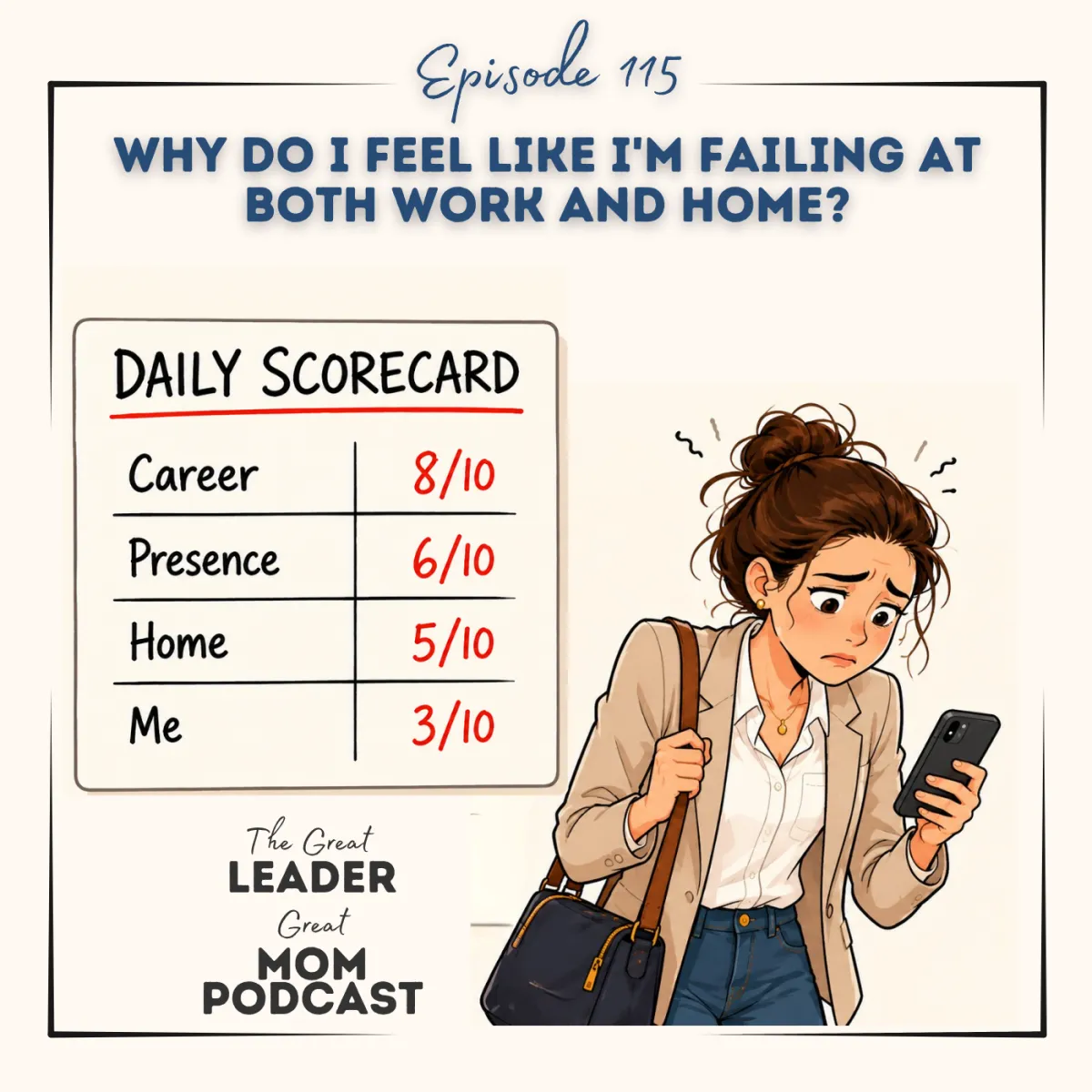
115: Feeling like you are failing at home and at work
Feeling like you are failing at work and at home may not mean you are doing either one badly. Learn how an impossible internal scorecard turns ordinary disappointments into self-blame—and how to respond with love instead.
View Full Episode Transcript
Why the Answer Isn’t Becoming More Perfect
[00:05] Welcome to The Great Leader, Great Mom Podcast. I’m Liz Jolley—engineer turned life coach, mom of three, and founder of The School of Courage.
[00:14] This is Episode 115, and we’re going to talk about why you feel like you’re failing at work and at home—and why the solution isn’t becoming more perfect or getting everything right.
[00:25] The way forward begins with deciding what “good” actually means to you, on your own terms.
When the Vacation Did Not Go as Planned
[00:29] I’m glad you’re here. I’m also so glad to be back in my house this week. I just took my three kids to the Frio River in the Texas Hill Country.
[00:39] If you’ve ever been there during the summer, you know what we were hoping for: endless sunshine, cold water, rope swings hanging from incredible trees, hiking, exploring, and so much time outside that by late afternoon everyone wants to escape the sun for a while.
[01:01] That was the plan—but it was not what happened.
[01:06] Instead, we experienced what was described as a one-in-one-thousand-year rain event. There was horrible flooding nearby in Uvalde. Water flowed directly over the roads, and at one point, we literally couldn’t leave because the roads were blocked on both sides of us.
[01:29] The park we visit was completely shut down. All the while, I was watching my own brain with fascination. Almost immediately, when the rain began and flooding was forecast, my brain started telling me: You should have planned this better. You should have picked somewhere else. You should have gone to San Francisco like you did last year.
[01:52] The kids aren’t going to have much fun on this vacation. My brain began creating these almost comical stories—as if I should have forecast the weather four months earlier when I booked the trip and known this would not be the ideal week for sunshine.
[02:15] Somehow, my brain decided I should have prevented this massive rain event—as if it were my fault.
[02:21] It was as if my packing list included boxes for sunscreen, extra towels, and controlling the weather. That is obviously ridiculous, but this is what happens to so many of us with perfectionist brains.
How Perfectionism Turns Reality Into Personal Failure
[02:40] Perfectionism isn’t only about trying to control ourselves. It is also an attempt to control reality and everything around us. Then we blame ourselves when something refuses to cooperate or something unexpected happens.
[02:56] Instead of simply noticing that the situation is disappointing, inconvenient, or hard, our brains start searching for the mistake we must have made. We think we should have known better or prevented it.
[03:08] For so many of us, the answer is always that it was our fault. If we had planned better, worked harder, or been more organized, patient, thoughtful, or prepared, maybe it wouldn’t have happened and everything would have been better.
[03:25] This doesn’t only happen on vacation. Maybe you’re in a meeting and the presentation doesn’t go the way you hoped.
[03:33] Your boss asks a question you can’t answer immediately. You say the wrong thing or fumble your words. Someone on your team is upset, and your brain says: You should have seen this coming. You should have handled it better. You should have known what to say. A strong leader would have done better. A high performer would never let this happen.
[03:52] Then you come home and your child is melting down. Nobody can find what they need for school tomorrow. Dinner isn’t going to prepare itself, and your patience is gone.
[04:02] The same voice appears again: You should be more patient. You should enjoy this more. You should have planned it better. A better mom wouldn’t feel frustrated or end up in this situation.
The Same Impossible Scorecard at Work and at Home
[04:12] For so many of us, it feels as though we are failing at work and at home. But these aren’t two separate problems. It is the same voice beating us up with a ridiculous set of requirements.
[04:26] It’s as if we keep comparing the life we are living to the life we think we should be living—and the scorecards never add up.
[04:40] At work, we aren’t doing enough. At home, we aren’t being enough. Underneath both is the same thought: If I could just do better—if I could do everything more perfectly—then everything would finally work.
[04:53] If I could get myself together, my marriage would feel easier. My kids would be happier. My team would perform better. The house would run more smoothly.
[05:03] Maybe then we would finally feel present at home, or less frantic and out of control. But we are trying to become a fictional future version of ourselves who never makes a mistake. That standard is both impossible and unreasonable.
[05:19] That future-perfect version of us doesn’t actually exist. We use her only to compare ourselves to where we are now and catalogue how we are falling short. It is never helpful.
[05:30] Perfectionism has no finish line. There will always be something else to improve or another way for our brains to beat us up.
Separating Reality From the Story
[05:39] This is what was happening to me on the trip. The facts were that it rained, the roads closed, and the river rose to about 17 feet from its normal 4.5 feet.
[05:49] The story I told myself was: I planned this badly. I’m disappointing my kids. They aren’t going to have any fun. Those thoughts created guilt, and then I looked for evidence that I wasn’t doing the vacation correctly.
[06:05] In reality, I cannot control Mother Nature, and I cannot control my children’s experiences. I get to control myself.
[06:16] There was nothing wrong with wanting sunny days on the river and watching the kids swing from ropes into the water. The problem was pretending that every circumstance—and I—should be perfect.
[06:29] The way out is to separate reality—what actually is—from our version of what we think it should be. Then we can have compassion for ourselves.
[06:40] I could notice my brain creating wild stories about how I should control the weather, even though I couldn’t. When I was consumed by the fact that I couldn’t control it, I wasn’t being the person I wanted to be.
[06:49] The more I returned to the reality that I am human and many things are outside my control, the more I could ask: How do I want to be in this moment?
[06:59] I wanted to bring fun and love. I wanted to accept that this was the vacation we had and ask how we could make it joyful, while still allowing ourselves to feel disappointed.
[07:06] We played Heads Up Seven Up, and it was hilarious. We laughed and had a great time together. We made fires in the rain and cooked food. We even tried ridiculous things with rafts on the dirt instead of in the water.
[07:24] It was still our vacation, and it was still fun. Yes, reality was the exact opposite of what I expected—but that was okay.
What If You Are Not the Problem?
[07:32] How often do you compare what is actually happening to a fairy-tale version of what it should be, and then make the difference mean something painful about you?
[07:42] The meeting went differently than you imagined. Your child responded differently than you expected. Your career looks different from the one you pictured.
[07:50] Your brain translates those differences into: Something has gone wrong. This is a problem. I need to fix myself. I need to do something differently.
[08:00] But what if you aren’t the problem? What if the problem is the impossible standard you are using to judge yourself and your life—a version that doesn’t actually exist?
[08:11] Holding ourselves to that standard only disappoints us and creates suffering.
[08:18] Good leaders don’t prevent every disappointment. Good moms don’t keep everyone happy all the time. Capable women don’t anticipate every single problem.
[08:31] Successful women carry invisible loads, and they get tired. Grounded people feel overwhelmed. This is reality.
[08:39] When we measure ourselves against a version of life in which we never feel a negative emotion, experience anything painful, or struggle, we cannot succeed. The rules of that game were impossible from the beginning.
Create Space and Ask What Love Would Do
[08:49] When you hear that little voice saying, You should have handled this better. You should have known. You should have controlled the weather. You should have prevented this—create a little space.
[09:01] Slow down and notice the voice. It is the perfectionist part of your brain trying to make you responsible for everything.
[09:07] Then ask yourself a question I love: What’s going on, love?
[09:13] Maybe you’re disappointed. Maybe you’re exhausted. Maybe you’re afraid someone will be unhappy with you. Maybe you’re worried that the outcome means you aren’t as capable as you thought.
[09:25] That is all okay. You do not have to criticize yourself out of being human. Then ask: What would love do here—for everyone involved?
[09:29] Maybe love would prepare for the next conversation without replaying the last one for six hours. Maybe love would acknowledge that you made the best decision you could with the information you had.
[09:40] Maybe love would allow your child to feel disappointed without making that disappointment mean you are a bad mom. Maybe, instead of stressing yourself out to make dinner, love would say, “We’re ordering pizza or eating Chick-fil-A.”
[09:53] It’s okay. We can still love ourselves when we don’t meet our own expectations. We are never going to become the impossible, fairy-tale versions of ourselves we’ve created.
Make the Decision From Your Grounded Self
[10:05] This matters wherever you are in your life. Maybe you’re at a crossroads and keep telling yourself, “I can’t keep doing this. My job is too much.”
[10:14] The family responsibilities feel overwhelming, and you don’t know what to do. Many women I talk to believe leaving is what they must do to feel better.
[10:24] But before you leave the job you’re in or the career you’ve worked so hard to build, I invite you to check out my free workshop on July 24 at 12:00 noon Central Time.
[10:35] You can find the link below. Come learn how to make decisions from your Grounded Self—not from guilt, overwhelm, or resentment. I want you to know what you want so you can make a decision that honors you.
[10:53] If you’ve been thinking, “I can’t keep doing this,” and you know something needs to change, check out the workshop.
[10:59] With that, I hope to see you next week. I also hope you’re having a wonderful summer. Take care, everybody.


