
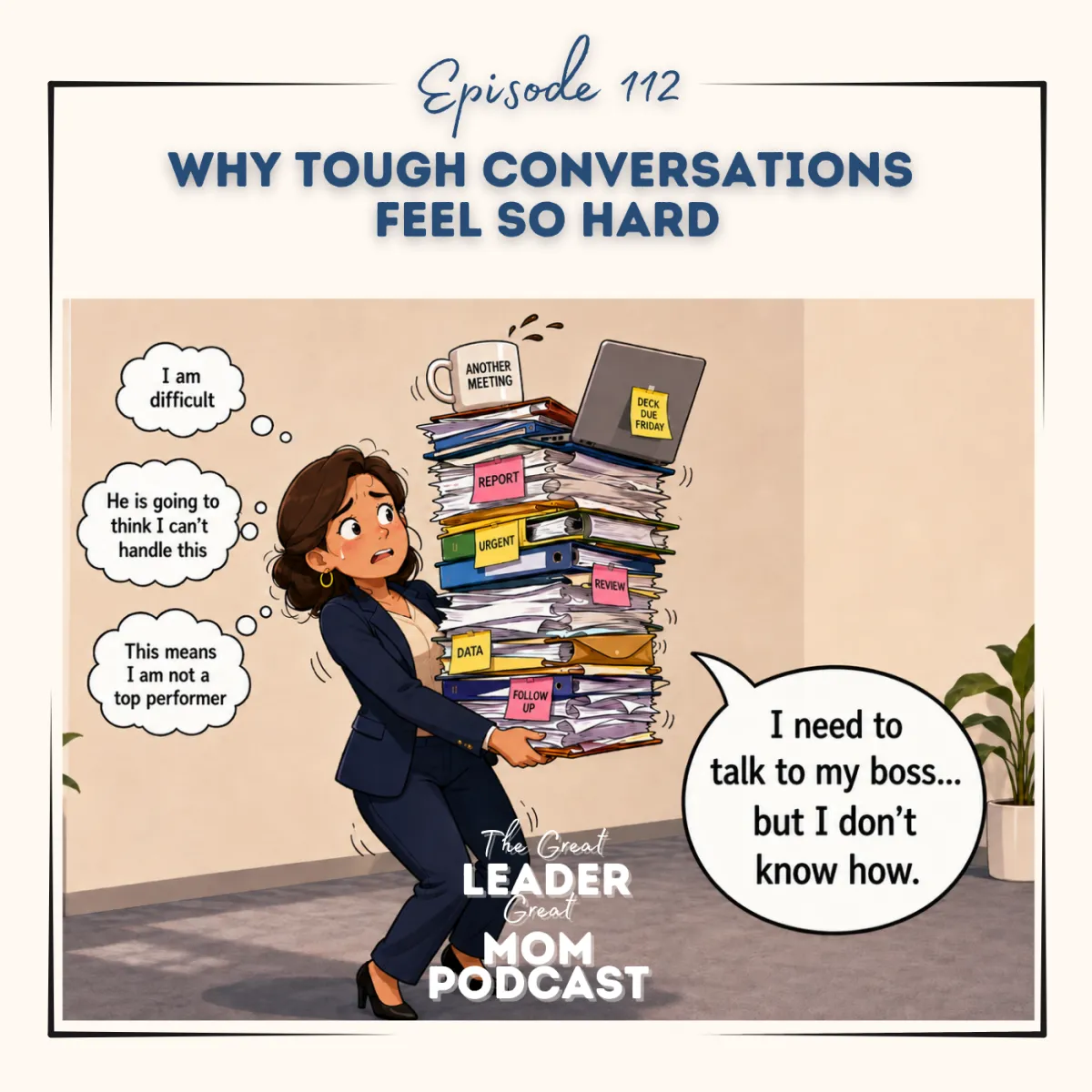
112 Why Conversations Are Tough
Tough conversations often feel hard because we are not just trying to communicate—we are hoping the other person will understand, change, validate us, or respond in a way that helps us feel better.
View Full Episode Transcript
00:00:01
Welcome back, my friends. I'm Liz Jolley, and this is episode 112 of the Great Leader Great Mom Podcast.
00:00:07
And today we're digging in deeper into tough conversations.
00:00:12
We're going to talk about the fundamental question: why do we call tough conversations tough? Because most of the time, the words themselves are actually pretty simple, right? You can say the words, “I need more help.” “The deadline is not realistic.”
00:00:28
“I'm not available for that.”
00:00:30
The sentences aren't the hard part of the conversation. The hard part of the conversation is everything we attach to the conversation. We don't just want to say the words. We want the other person to understand, to agree with us, to apologize, to appreciate us, and to see how much we're carrying, like the load at the house. We want them to respond in a certain way that, if you get down to it, is all about making us feel much better.
00:01:01
And that is a massive amount of pressure to put on one conversation. So no wonder we call them tough. So let's think about a conversation sitting in your brain right now that's going on in your life. Maybe it's with your boss, or your coworker, or your partner, or your teenager.
00:01:19
You know you want to say something.
00:01:21
But right behind that thought comes this wave of dread. So what happens? A lot of us don't say anything. We just wait. We rehearse it in the shower. It may keep you up at night. We replay it in the car. Maybe we talk to ourselves about it in the car. We write a text and maybe delete it. We tell ourselves, “I just need to find the right words.”
00:01:45
Meanwhile.
00:01:47
The thing that drove you to want to have the tough conversation is still there. It's just leaking out under the surface.
00:01:54
And for a lot of us, it shows up as though we're faking it. We say, “Oh, we're fine. Nothing's wrong. Everything's great. I'm doing just dandy.”
00:02:04
So we're making ourselves suffer because we're not having these tough conversations. But also, we really don't want to have the tough conversation because we're worried about how it's going to go.
00:02:13
There are so many things in a conversation we can't control. We wish we could, but we can't control their reaction, their opinion of us, or our own discomfort. So underneath our desire to just go and communicate, there's usually a sneaky, very human agenda, which is: I need them to change so I can stop feeling irritated or annoyed, or so we can feel valued.
00:02:38
So let's look at a work example.
00:02:40
I've had clients tell me, “Liz, tell me the exact words of what to say to my employee. They're being super negative, and I need them to stop without getting defensive or quitting.” And I totally get it. You know, I care about teams. Truly.
00:02:55
But underneath “I want to help them so they can grow,” there's often this part that says, “I need them to agree with me so I can feel like a good leader. So I know I'm doing a good job. So I feel validated.” And if you walk into the room needing somebody to respond in a certain way, you're going to end up bracing, monitoring their face,
00:03:15
and trying to manage their reaction in real time.
00:03:18
And what do I mean? This just usually doesn't work. So when somebody does get defensive, we leave thinking, “See, tough conversations just don't work. I didn't say the right thing. That was terrible.” But the conversation didn't fail just because it didn't control them. It doesn't mean we weren't successful in what we wanted to do.
00:03:38
Those are two very different things, which we'll get into in the series.
00:03:43
Maybe there's another example where you're feeling overwhelmed at work, and you want to go ask your boss about your workload. Then he adds one more thing to your plate, and you're already overloaded on your calendar just to even go to the meetings. And your brain starts spinning and says, “How do I push back without looking incapable or difficult?”
00:04:04
So notice what just happened. The conversation is no longer actually about the workload in terms of bringing it factually and talking it through from a prioritization standpoint. It's now about your identity. You're trying to protect your entire sense of worth in that room, right?
00:04:21
Because that feels like way too much to handle in a conversation, you may just stuff it down and go home and be super resentful and try to do a million things, which is literally not humanly possible. You can’t even go to all those meetings. Maybe you end up at home, and then you're short with your spouse or with your partner.
00:04:39
And when they ask you what's wrong, you're like, “Nothing,” but you're seething underneath the surface. So that brings us to the home example, where if you have a partner and maybe you want them to do more, and so you say, “Hey, the dishes are piling up. The kids are melting down.” You tell them, “I want more help,” but you don't want it to sound like you're nagging them.
00:05:02
And if we're being really honest, you don't just want help with the dishes. You probably want him to see the invisible load, like all the things you do at night, and just appreciate you.
00:05:13
So if a simple conversation about the dishes is secretly carrying the job of making your partner fully validate your good mom-ness or your handling of the house really well,
00:05:25
it's just a loaded conversation. It has impossible expectations. We can't control people like that. Sorry. If I could help you control them, I would be doing that. But we humans are more complicated than that. So when we're terrified of that tough conversation discomfort, we start to reach for what I call all the wrong vehicles to get us to where we want to go.
00:05:48
And none of these things are bad inherently, but we often use them as a defense mechanism to avoid the real work.
00:05:56
So here's the first one I want to talk about: we outsource our words.
00:06:00
When we want to have a tough conversation, we may go to Google or ChatGPT, or a friend, or HR and say, “Tell me exactly what to say.”
00:06:09
I love a clean sentence. Don't get me wrong. But a script cannot clean up your resentment, and it can't guarantee a perfect reaction from the other person. We're just not that powerful. A script is a tool. It's not the work that actually prepares you to go have the conversation. So the other thing we do that really doesn't work is we vent to people.
00:06:30
Instead of actually cleaning up our conversation before we go in,
00:06:35
what this looks like is when you talk to everybody about the person, but you don't actually talk to the person. You're talking to your sister, or your best friend, or the poor mom next to you at the soccer game, or your spouse about everything that happened at work, or your coworkers about your boss. And it may make you feel validated for a little bit,
00:06:57
or give you a little bit of relief, but
00:06:59
it doesn't actually solve the problem. You're not giving yourself what it is you really want in these moments, so that doesn't work. The third thing I see people do is we just sort of hint and hope our way into something magically happening and them changing. So instead of saying, “I need you to handle bedtime on Tuesdays,” we sigh dramatically.
00:07:20
And then we overreact by slamming the dishwasher door or stomping out of the room.
00:07:27
We're hoping all of our not-so-subtle hints actually communicate what we're not saying in our words, instead of really being our authentic best self and bringing it up. Hinting feels safer, but it kind of isn't. And frankly, you're just adding to conflict and confusion and all the things you really don't want.
00:07:46
Probably the opposite direction of all of it. So the fourth thing I see people do is we hide behind systems. And this is obviously among all of our corporations, where we put feedback into an anonymous system. Or maybe it's not anonymous, but it goes from us to the person's boss, most of the time without any context. And most of the time, that feedback is very vague, as we've talked about a couple episodes ago.
00:08:12
So, not helpful. And we're hoping that, you know what, I'll feel a lot more comfortable if I can just type it in anonymously, or where I don't have to explain myself and actually look somebody in the eye. But it doesn't actually help change anybody. We hope that, magically, the boss will read the feedback about their person and then change them, which just doesn't work because they don't have the context. They don't know.
00:08:38
And so while it may feel slightly more comfortable, it's not really, truly the best way to have the conversation that actually addresses what it is you're after.
00:08:49
The fifth thing I see people do is
00:08:51
we spend so much time over-preparing and mulling it over that we explode. So we may write an email and delete it, rewrite it later,
00:08:59
decide on Friday that it isn't the right day, and Monday is not the right day either. And then three months pass, and the pressure has built up, and we're just ready to explode. So one little thing happens, and we kind of snap, maybe. And then we call it honesty, like, “I just spoke my mind.” But honesty without self-awareness is just a wrecking ball.
00:09:17
Not helpful. So here's the solution: grounded conversations, which is where I want all of us to shift to from tough conversations. They are not about dumping, proving your side of the story, or forcing someone to finally understand you. A grounded conversation begins before you even open your mouth, when you stop and trade in your agenda for a clean reason to go speak. You've got to clean up your own side, your own brain.
00:09:46
So
00:09:46
instead of saying, “I need my boss to stop giving me work so I can stop feeling panicked,” try the cleaner reason, which is, “I want to clarify the priorities so we're aligned on what's realistic here, and he can actually understand all the context that goes with this list because he probably doesn't know.” So
00:10:04
instead of, “I want my partner to see everything I do and feel bad about it and then apologize,” the better reason would be, “I want to ask for a new agreement at night and stop silently carrying all the resentment.”
00:10:18
The new reason might be, “I want to bring this up and talk about how I want to share this load. What can we do? How can you help out?” Not from a place of resentment, but from a clean emotion, which we'll talk about next week. The clean reason doesn't require the other person to have a perfect response. It doesn't.
00:10:35
You have to hold space for their response. It puts you back in your lane. I love the Byron Katie quote that says there are three types of business. There's your business, my business, and God's business. And a lot of times we're spending all our time in other people's business or God's business, or the universe, whatever you want to call it.
00:10:54
And we have no control there. So we need to do our part, and that is to clean up our reasons as to why we want to have the conversation. Get honest about, “Why am I calling this tough? What do I wish would magically change in all of this?” And then we're going to get specific, tell the truth with kindness to the person, not go talk about them.
00:11:15
And then we want to have our own back afterward and hold space for whatever their response is.
00:11:21
Their part is theirs. They may get defensive. They may need more time to process. They may literally never change. But you can still be grounded in any room, no matter what is happening. And you can be your authentic, true self.
00:11:36
You don't need another person to respond perfectly for you to live truthfully. You don't need them to validate you before you're allowed to belong to yourself. So here's your practice this week. Think of one conversation that you're calling tough or actively avoiding. And before you ask, “What should I say?” ask yourself, “What am I hoping this conversation will give me?”
00:11:56
“What am I wishing would be different about this?” Just get curious. No shame, no judgment. Don't go beat yourself up over this. And if there's a conversation you keep replaying, dodging, or rehearsing, come to my upcoming Tough Conversations to Grounded Conversations workshop. We aren't going to hand you a robotic HR script, I promise. I'm going to show you how to slow down the conversation you're carrying.
00:12:18
Look at what's underneath it so you can clean it up before you go and say the words to whoever it is from a place that's your authentic, clear self. Go to LizJolley.com/grounded to sign up.
00:12:31
Let's do the work so that we can go be our Grounded Self in any room we're in.
00:12:35
With that, take care, everybody. I'll see you guys next week.


