
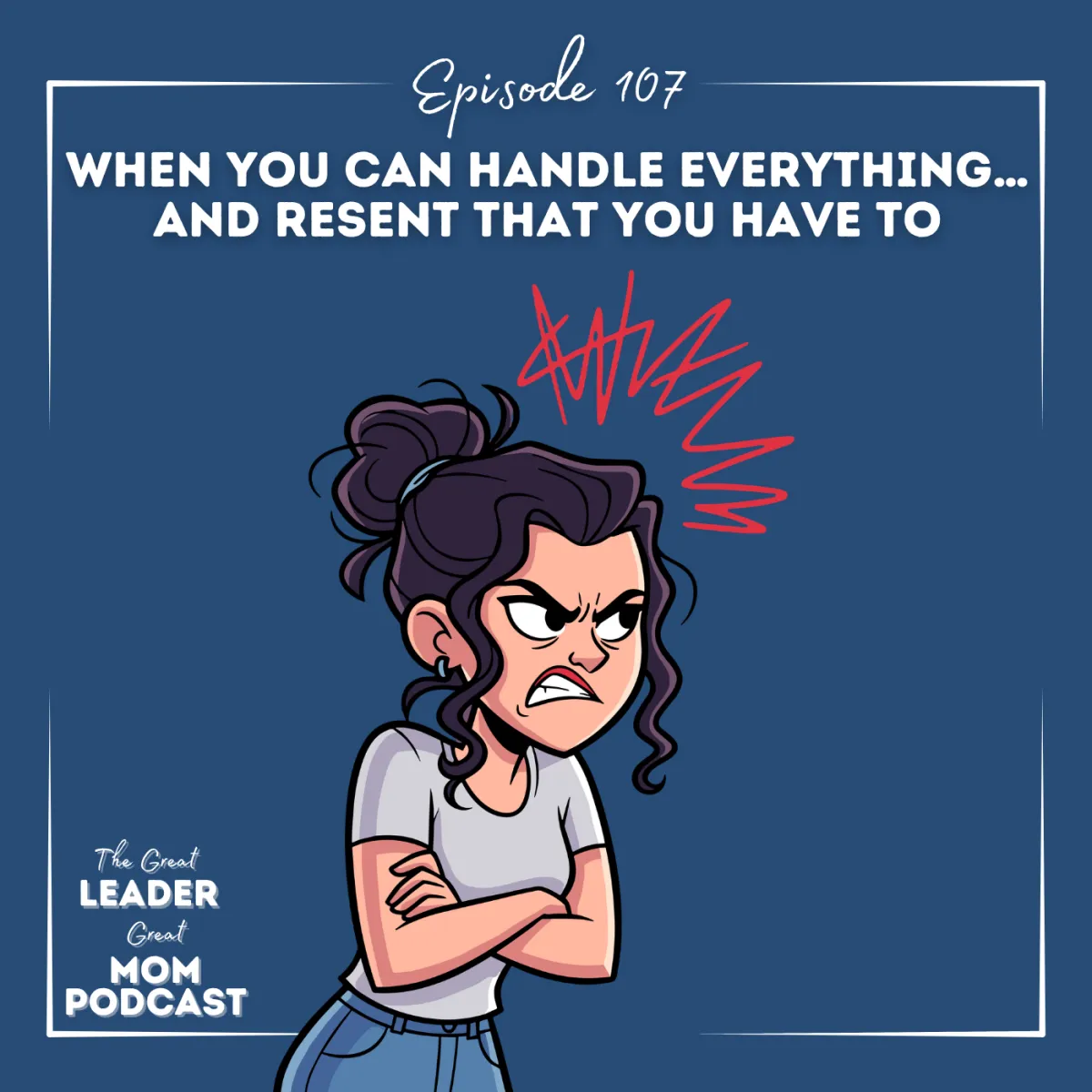
107 We Resent The Life We Worked So Hard To Build
Resentment is often a sign that something underneath you needs attention: an unspoken expectation, a boundary you have not set, or a story you keep replaying.
View Full Episode Transcript
00:00:20
Welcome to the Great Leader Great Mom Podcast, where we trade in mom guilt and burnout for courage, calm, and a whole lot more joy. I'm your host, Liz Jolley, engineer turned life coach, mom of three, and founder of the School of Courage. Here we talk about leading at work and at home without losing your sanity, your sense of humor, or yourself.
00:00:23
This is episode 107.
00:00:46
And today is all about when you are capable enough to handle everything, and you deeply resent the fact that you have to. So how many of you have ever thought, “Can everyone please stop needing me for five minutes?” And I know you love your spouse and your kids and all the things, but when you instantly feel annoyed the moment you walk through the door, when they say, “Mom, what's for dinner?”
00:01:10
Or when you care about your career and you feel this wave of irritation when someone sends you one little extra message right before you're about to leave, or they pop into your office to do small talk, and you're feeling completely underwater. And then comes the lovely layer of guilt. Because what kind of mom, wife, or leader feels irritated when people want to connect with them?
00:01:31
Well, this is all of us. Welcome to being human. Today, we're exposing the quiet resentment that builds inside all of our lives that we worked so hard to create. And for most of us, the problem isn't that we can't handle all the things, because we are brilliant jugglers. I've seen you all. We handle the project deadlines, the really challenging work.
00:01:55
We do all the appointments for our kids. We do the school forms, the endless groceries, managing the house, and then we deal with all the other things that just pop up in our life and with our family's life. We make it all work. We do. We're really good at this. But then we feel resentment because everybody just expects us to do all the juggling and all the things.
00:02:03
Often, it feels so much like the whole system is built on this assumption that you're just going to handle everything. You got this.
00:02:17
And then one day your kids ask you, “Mom, what's wrong?” And then you realize you're making the face. You know, the face with the furrowed brow, the clenched jaw, the scowl. And it's the face you didn't even know you were consciously making.
00:02:38
Because internally, you're feeling the resentment, and you're just trying to survive and fight it all out. Your brain starts telling you these things like, “Everybody needs me,” and it's not in a sweet, heartwarming way from a place of love. It's in this tight, resentful, “Just go away and need somebody else for five seconds” type of way.
00:02:58
And I want you to know that this is all of us. You're not a terrible human or an ungrateful mom. You love your life. And that's what makes all this resentment feel so shameful. You look around at your family and the career you built and think, “This is what I wanted. Why do I feel so angry inside?”
00:03:10
Well, resentment is not just a bad mood. It's not a moment that you're stuck in. It's this emotional window that we need to use to look inside our brain and examine our thinking.
00:03:22
If we notice that this is the moment we've gone unconscious, we're living on default. We're reacting to the world around us. We're sitting here waiting for the world to notice us and make us feel appreciated.
00:03:48
We get bitter because we didn't get a gold star, or nobody noticed us and thanked us. Nobody was standing there to say, “I noticed how much effort you put into that project,” or “I noticed how much effort you put into getting that big deal across the line.” Instead, we get complaints or more requests or just silence, which our brain fills with all sorts of stories. And then we beat ourselves up for feeling resentful in the first place, right?
00:04:15
So if we define resentment, it's the feeling of carrying a grievance. It's the sense that something unfair has happened to us, that someone owes us, and we are waiting to get paid back. Your brain says, “This shouldn't be so hard. They should notice.” And it's like you're walking around with an invisible invoice. “I did the laundry. I stayed late. I remembered all the things. And now somebody owes me some appreciation.”
00:04:41
It's the least they could do. But here's the catch. Nobody knows that they've been invoiced. Everybody is just living their own messy human life, trying to figure it all out. And so they don't do what we think they should do. And we may not say this out loud or tell anybody, but all of a sudden we are in this mode of resentment, and resentment becomes our strategy for trying to get some appreciation.
00:04:59
And I think it's like emotional bargaining, where we're mad that we have to make dinner and nobody did anything while we were at work. So then we angry-cook, and we bang the pots and pans around, hoping somebody will notice that we're upset and come in and make us feel better. Or we breathe a little too loudly, like a big sigh.
00:05:19
Or we scowl, or we storm out of the room just a little too emotionally. And our brain thinks, “Surely if I look miserable, somebody will notice how much I do, and they will comfort me.” But they don't, right? They assume everything is just handled because you always handle it, and your brain just gets more and more angry.
00:05:26
It's like the snowball that just builds. So here's the reality. Resentment, when it pops up in our lives,
00:05:45
is not their problem. It is an internal problem. And so whoever is driving you crazy right now, it's not their fault. We need to take back our emotional responsibility. And when we think that they're the problem, that they need to change, we've given away all our power.
00:06:05
We think, “If my spouse helped me more, I'd feel better.” And then we go into, “This should be 50/50 in our world. Don't they know this?” Or we think, “If my boss appreciated me, then I would enjoy this job and I could contribute more,” or “I should go look for a new job.” And those things might work and might make us feel better for a minute.
00:06:31
But real resentment, at the root, is not solved by other people finally behaving the way we think they should. If your spouse changed, your brain would find the next thing to be resentful about because they're always going to be falling short of your expectation. Your internal settings haven't changed. The thoughts you have are always going to be there ruminating unless you address them, unless you question them.
00:06:56
And so many of us don't even realize that we've set ourselves up for these two terrible options. We think, “Okay, option one is I keep giving and giving and giving and stay completely miserable because I'm giving from a place of resentment. Or option two, I stop giving entirely, also from a place of resentment, and I burn the whole thing down and walk away. And that's it.”
00:07:15
Both of these are terrible options. Neither creates what we really want, which is connection, love, presence, being valued. And when you give from a place of resentment, you are the one that hardens. You are the one that suffers. You become less fun to be around. And honestly, do you want to hang out with yourself when you're wallowing in resentment?
00:07:17
Probably not.
00:07:36
So to break the cycle, we have to catch the hook: the sentence in our brain swirling around causing the resentment. That is what triggers you, not the other person. The biggest clue is the phrase “I have to.” Listen to your internal monologue. Really write it down.
00:08:02
What are all the things I have to do? You might list, “I have to pick up the kids. I have to make dinner. I have to go to the grocery store. I have to answer the email. I have to do all the things on my project team because they're not doing it.” The moment you think, “I have to,” you make yourself a victim to the life that you chose to build, the life that you're in, the people around you. And all of us have practiced this for decades probably.
00:08:21
To fix it, we have to use our resentment as the emotional window into our brain to say, “That's my alarm clock. Let me look at what's going on. What are the sentences swirling around up there?” And examine them. We ask ourselves, “Why do I feel resentful right now? Do I actually need to do this thing? What if I didn't actually have to do it?”
00:08:31
“What are my actual options? What is it I really want here?” And be really honest, because even though you want somebody to change, they probably never will.
00:08:42
What is it you deeply desire in this moment? This isn't about pretending every choice is supposed to be magical and easy, because sometimes the options are uncomfortable and annoying.
00:08:57
And so this is all about reclaiming your power to choose consciously. So let me give you an example from my own life. When I go to school pickup, my brain often goes to, “I have to pick them up because they didn't ride their bikes. Why didn't I make them ride their bikes?” And then I feel terrible.
00:09:16
But if I really believe that thought and I get in the car and go to pick them up at school, I show up irritated, and I'm ruminating on the fact that they didn't bike. And then when the kids get in the car, I'm kind of snarky. And yes, I'm there physically present, but my energy is totally from a place of resentment.
00:09:39
I don't ask about their day. I don't help them with their backpacks. I just rush them in the car to get home because I don't want to be doing that. But if I instead pause and ask myself, “Do I actually have to pick them up?” And the honest answer is no. They could walk. We live so close to school. They could carpool with the two people literally right next door that go every single day at the same time to pick up their kids as well.
00:09:58
So there are totally other options. So if I am choosing to drive, why am I choosing to drive there? The reality is, I want to see their faces. I want to pick them up. I want to be the one who hears about their day. I want to do it from a place of love, not a place of resentment that just moves toward disconnection.
00:10:01
They're going to get grumpy if I show up grumpy.
00:10:22
We don't feel resentful because of the people around us. We feel resentful because of the hot mess going on in our mind, and we get to choose. It is entirely up to us. Our three choices look like this just about every single time. There's the first choice: you can do the thing from a place of love, even love for yourself or value for yourself.
00:10:39
You can do the thing from a place of resentment, which, as you know, feels terrible. Or you can decide the most loving thing to do is to say no and not do the thing at all. All choices can be valid. You have the agency as an adult to choose whatever you want. Just make that decision consciously.
00:10:46
Stop walking around and doing a million things and waiting for everybody else to notice you and validate you.
00:10:51
One final note on resentment. When we feel resentful,
00:10:59
it's almost always fueled by a little bit of self-pity. It's that voice that whispers, “Poor me. I'm doing this all alone.”
00:11:26
“Nobody sees how hard this is.” And self-pity feels a little cozy sometimes. But when we wallow there for too long, it has zero upside. It'll never create the joy, connection, or value we really, really want. And nobody leans in to somebody who's drowning in self-pity. It just creates more distance and more disconnection. Your value as a leader doesn't depend on your boss giving you a gold star today.
00:11:49
Really, your happiness as a mom does not depend on your family perfectly acknowledging and thanking you for all you do. When you feel the bitterness rising within, let that be your signal to go and examine what is on your mind. What are those sentences in your head creating the resentment? Ask yourself, “What do I actually want to create here?”
00:11:57
And let's dismantle the resentment among all of us. At the root, choose to show up consciously from a place of love.
00:12:08
And if you're waiting for the world to make you feel valued, you're doing it the long way. And so whatever we want the world to give us, we have got to learn to give it to ourselves first.
00:12:26
If you want to do this work on a deeper level, join us in the School of Courage. Go to LizJolley.com/membership and check out what it looks like to be a part of the School of Courage. I hope everybody has an amazing week, and let's drop the resentment and the scowly faces. We don't need that for our lives.


