
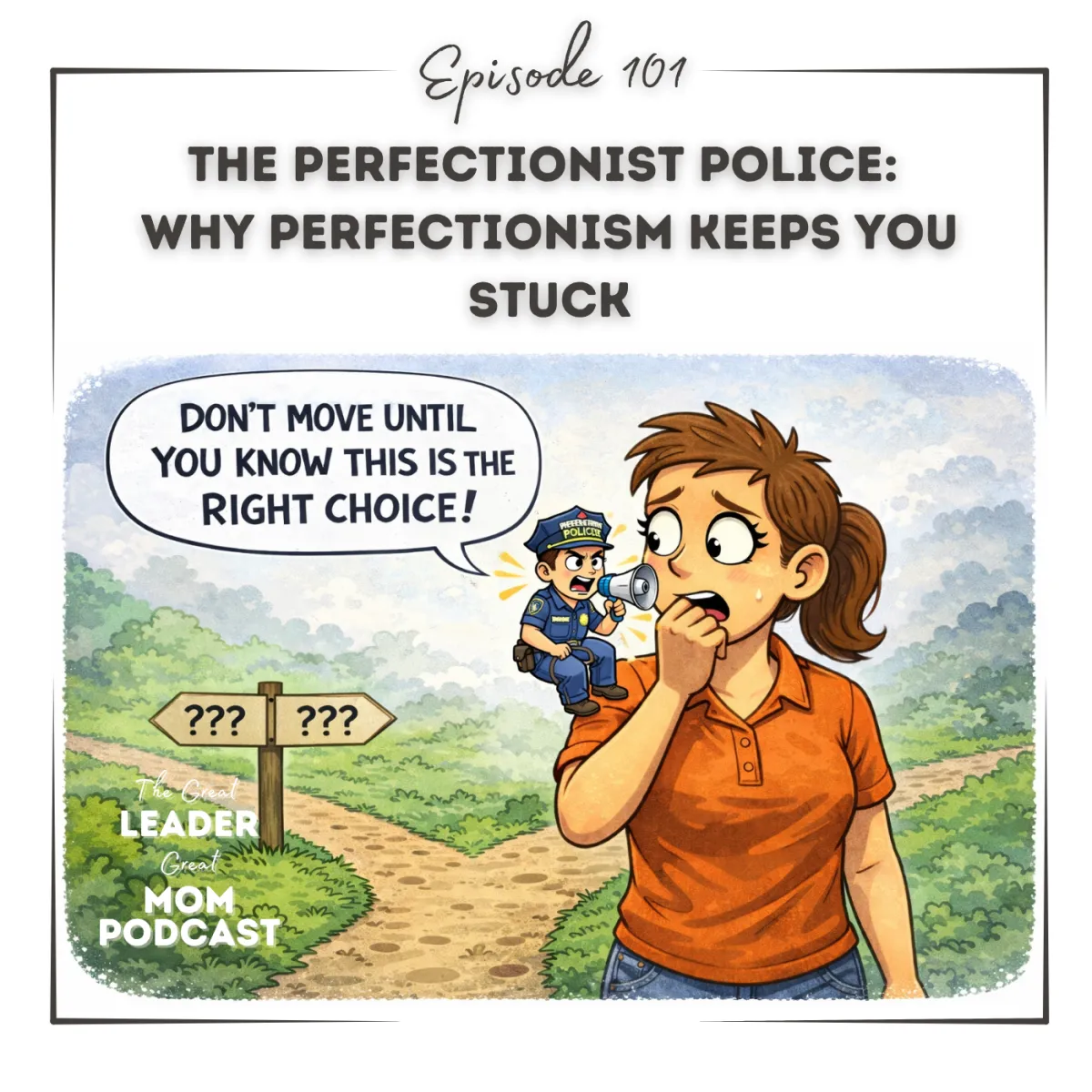
101 The Perfectionist Police: Why Perfectionism Keeps You Stuck
Perfectionism can sound responsible, but it often keeps women confused, afraid, and stuck. In this episode, Liz Jolley explores how the inner critic uses perfectionism to avoid shame, regret, uncertainty, and failure — and why real self-confidence comes from being willing to feel any emotion and take imperfect action anyway.
View Full Episode Transcript
00:00:01:14 - 00:00:34:18
Welcome to the Great Leader Great Mom podcast, where we trade in mom guilt and burnout for courage, calm, and a whole lot more joy. I'm your host, Liz Jolley, engineer turned life coach, mom of three and founder of the School of Courage. Welcome to episode 101. This is all about the perfectionists police. We're in a series on naming your inner critic, and I think this one will relate to many of you because have you ever noticed that the moment you need to make a decision, your brain starts demanding all kinds of evidence and certainty?
00:00:34:20 - 00:00:59:23
And it acts like if you just think a long enough, if you stress long enough, if you analyze long enough, you'll finally land on the perfect answer. What's happening here is your inner critic that we're calling the perfectionist police is on duty, and it's their job to prevent you from growing, because it really wants you to avoid all the feelings that we humans like to avoid, like shame, disappointment, failure, discomfort, and other things like that.
00:01:00:00 - 00:01:23:24
Because the perfectionist police that voice in your head. It's saying all the time, don't move until you know this is the right choice. You don't want to make a mistake. It sounds truly responsible and careful and like it's protecting you. But underneath it, what's really going on is it's just trying to avoid those emotions, which it tells you are terrible and you should avoid.
00:01:24:00 - 00:01:50:09
So when you find yourself really wanting to do things perfectly, it's not about high standard. It's about you avoiding those emotions which your brain considers negative and No-Go territory, which welcome to being a human. We're supposed to feel the full range of emotions, including disappointment, uncertainty, failure, and discomfort. And these are the emotions we actually want to experience.
00:01:50:09 - 00:02:16:10
Yes, you heard me say that right? Because if we don't want to feel discomfort or failure or disappointment, we're never going to try anything. And it's really, truly going to keep you stuck in your life. You're not going to take risk because you're so afraid to put yourself out there. I like to think of the analogy of if you're two people and one of them is standing on the same trail and they're willing to make mistakes, they're going down the trail.
00:02:16:10 - 00:02:44:02
They're coming to a point where they could take a turn and they're like, I don't know exactly which way to go. I'm just going to go this way and try it and say it doesn't get to where they think they want it to go, but they're moving forward. Whereas the perfection person back there at the start still is trying to figure out if there's a map or somebody they could talk to to find the way that shortcuts all of the trial and errors and gets them to what they deem as successful way quicker.
00:02:44:04 - 00:03:10:02
But in our lives, we don't want to stay stuck. We don't want to be putting ourselves in the cave because we're so afraid to go out there. And then we never go out there. We never even find out what we're capable of. So the perfectionist policed. She's not helpful. Here's some examples. If you're at work and you're thinking about, say, a promotion or a job change, maybe it's even taking on a new project and your brain says, oh my gosh, what if this is the wrong move?
00:03:10:04 - 00:03:35:11
What if I fail? What if I pick the option and it hurts my family or my marriage? Or it derails everything? Notice your brain catastrophizing here so suddenly your brain took a decision and made it a life or death event. One of the things I want to point out is your brain is offering you a string of stories, a string of facts about some decision, and it's all in the future.
00:03:35:11 - 00:03:54:02
It's like, oh my gosh, in the future, if I decide when I think about where I'm at based on the decision I made, if this was not the right decision, I'm going to feel terrible. Your brain is living in decision fairyland. Like if you make the wrong decision, it's all going to be terrible and all these bad things are going to happen.
00:03:54:07 - 00:04:16:15
That is all a story you make up in the future about where you're at, and you're blaming some decision like it has that type of control or power over your life and your feelings. It really does it. It's the story you tell about it. It's your thoughts about it that creates your feelings. Ergo, your experience about your life in that moment.
00:04:16:17 - 00:04:34:15
The perfectionist place is telling you, yeah, but what if you're not a good enough mother? You're not perfect. Your house is a mess. Or if it's either at work or at home and your brain's like, what if you're just not doing enough? What if you need to do more to earn more, or you'll fail? Or your brain tells you what?
00:04:34:15 - 00:04:57:09
If you choose the wrong school for your children, or the wrong routine, or the wrong meal, and you don't feed them all the healthy things? Or if you have the wrong response with your boss or your spouse or your neighbor and it all goes wrong. Your brain is not just asking for wisdom, it's demanding perfection. And it's in this decision fairy tale land.
00:04:57:11 - 00:05:19:23
Like, if you could make the right decision, all these things would pan out perfectly and you would avoid discomfort, shame, all the things we want to avoid. Here's one of the interesting things about the perfectionist place. She's whispering in your head, and she's probably causing confusion and confusion for us. Feel safe because it's like, I'm going to delay taking action so I have the right idea when we stay.
00:05:19:23 - 00:05:41:11
And I don't know, then we risk having to get it wrong because we've taken no action. What's sneaky about this is if you live in the realm of I don't know, you don't feel embarrassed, you don't feel regret, you don't have to sit in disappointment. I don't know is not helpful. But in the perfectionist realm, it comes up a lot and it feels safe.
00:05:41:11 - 00:06:00:16
Like if I could only just find more information and get the right answer. But again, confusion leaves you back in the trail, stuck at the turn, trying to figure out if there's a right way. And again, you're stuck. You're not moving forward. It feels protective. It feels like, yeah, but I'm just looking for more data. But it's totally a trap.
00:06:00:18 - 00:06:21:18
I really want to be clear here. The problem isn't lack of information when it comes to decisions or putting something out in the world. It's this fear of feeling. It's the fear of those negative emotions like, what if I'm not good enough? So the perfectionist police, she is telling you that there is a perfect decision waiting out there for you somewhere.
00:06:21:23 - 00:06:50:00
This perfect answer. There's perfect timing for everything. A perfect version of you. And once you find it, everything is going to feel amazing. But that is a total lie. Thank you. Perfection. Police. Not helpful. There is no decision that will guarantee no discomfort. There's no choice that'll make you feel immune to any doubt or no fear. There's no life path that'll prevent you from disappointment for the rest of your life.
00:06:50:02 - 00:07:07:23
Even though it's kind of learning to think that out there. If you're waiting for the perfect answer before you move, before you make any decision, before you put anything into the world, you're waiting for a feeling that doesn't exist. It's the long way. Like you're going to be back at the start trying to figure out which way to go.
00:07:08:00 - 00:07:37:12
That certainty is not part of being a human. Life works in the way that there is no certainty. You just have to be brave and afraid all at the same time and just step out there. So let's think about someone deciding whether to take a new job. The perfectionist police may say, I need to know that I will be competent in this job, that it will be a fulfilling job, that it will be great for my career, that I'll be respected, that I'll get that promotion, that it'll be good for my family, my networking.
00:07:37:12 - 00:08:01:14
You want it to be guaranteed success to work out as the quote unquote right decision. And that's not decision making, honestly. That's your fantasy math going on. Like there's a right answer. And like the golden steps lay before you to walk on to get to this idealized version of your fairy tale dream life. And that's not humanity. I don't know if you looked around, but nobody's really living that life.
00:08:01:16 - 00:08:21:20
Let's go through a different example here about you deciding whether to set a boundary. Your mind might tell you, I need to know if, before I go have this conversation, that someone will understand my view, that they'll agree with me and they won't get upset. How many of you don't have hard conversations because of this mindset? That's not a boundary.
00:08:21:20 - 00:08:45:11
That's you trying to control another person's reaction. Here's the tragedy of the perfectionist police. You've lost your agency, your willingness to take action and trust that you're going to go figure it out in life because you've started acting like your future. Emotions that are created by your unmanaged mind in the future. Ergo, if you manage your brain, you could avoid them.
00:08:45:13 - 00:09:13:03
These are caused by the decision yourself like so. You're believing this lie that your future emotions like discomfort and shame and all the things are caused by the decision you made, but simply broken down. Your blaming, your feelings in the future based on the circumstance of your decision. And if you've listened to this podcast at all, you know that our feelings don't come from our circumstances.
00:09:13:03 - 00:09:45:04
They come from our thoughts about the circumstances. So here's this wrong equation our brain gives us. We think that if we choose wrongly, then we are going to feel awful. So we think that if the circumstance is not the right circumstance, that that's going to equate to us feeling bad, when really it's the thought in there that you think you chose the wrong thing, of course that'll make you feel awful, whereas you could make a choice and you could have your own back to never choose to feel awful about it, to look back and think.
00:09:45:08 - 00:10:10:03
We made the best decision at that time with all the data we had, and we're going to make the most out of it. This is about your curriculum and figuring it out when it comes to decisions, and it comes to the perfection police, the way out of the her lies is not asking yourself, but can I guarantee that I'll never feel bad and always be successful?
00:10:10:05 - 00:10:30:05
No. Your real question is, can I trust myself to feel bad and keep moving, to notice my brain and manage it and look at those thoughts and examine them when we think? I chose wrongly and be like no, I will have my own back no matter what, and I'm going to keep taking more action until I get to where I want to go.
00:10:30:07 - 00:10:51:07
That's taking the perfection police lies and just laying them down and stepping over them and being like, yeah, well, not today we're keeping on going because we got to get to some result. We're really after. Self confidence here plays a huge role. And many of you may think self-confidence is about the ability to get everything right, to know the answer, but it's not.
00:10:51:07 - 00:11:15:06
I think self-confidence is the willingness to experience any emotion, as in you take actions and your brain offers you thoughts that make you feel shame, embarrassment, failure, disappointment, uncertainty, discomfort, doubt. That's all part of the human experience. Nothing has gone wrong. That is how you build self-confidence. Knowing those feelings can just vibrate within you and not destroy you.
00:11:15:12 - 00:11:35:06
Even though your brain is like panic, this is bad. Let's go back in the cave. Self-confidence says, I can move even though I feel afraid. It says I can choose to learn and adjust and keep going. I know I can figure it out that this is just part of the process. It's not supposed to be easy and happy all the time to do hard things.
00:11:35:08 - 00:11:58:17
So let's take apart the part that many people need to hear, including myself a lot. Is that messy action is where the growth lies. It's where the delight, where that real self-satisfaction comes from. That's self-respect, whereas perfectionism, it just leads to analysis paralysis. So when you wait for perfect clarity, you don't actually get safer. You just get more stuck.
00:11:58:17 - 00:12:21:09
You're way back at the start trying to figure out which way you should go. Instead of just going somewhere and trying it, you become more self-critical. You become more tired because your brain is iterating around all the different negative outcomes that could happen and what it means about you. If that happens. And often you're more disconnected from your own power, which all of you need to be connected to your power.
00:12:21:09 - 00:12:48:09
That's where your amazingness lies. You're going down the trail, making progress, even if sometimes it feels like it's three steps forward, two steps back. You're moving forward. You're practicing holding space for all those emotions which your brain tells you you should avoid, which makes you even more amazing and even more capable of doing the hard things, putting yourself out there and seeing what you're capable of.
00:12:48:11 - 00:13:09:12
So maybe it means you send the email before it's perfectly worded. Maybe means you apply for a role before you're 100% ready. Maybe it's you have the hard conversation before you have memorized your perfect script. Maybe it's you try a new routine, a new boundary, a new habit, a new goal before you feel fully confident. And yes, you're probably going to feel awkward.
00:13:09:12 - 00:13:33:02
It's probably going to be terrible the first time you've done it, and you might be embarrassed, disappointed, shame. You might even feel failure. But that's okay. The way out here is you decide. You learn to trust yourself. So the next time your brain says, I'm confused, pause and ask yourself, what am I afraid of here? Look for the emotion you're afraid to feel.
00:13:33:02 - 00:13:59:18
Because sometimes it's. I'm afraid people are going to think I'm ridiculous, ergo embarrassed. I'm afraid. Like I'm going to fail and I'm going to feel shame, like I'm not good enough. If you can realize what is the emotion you're trying to avoid and move through it anyway and be like, I'm willing to feel embarrassed. I am willing to feel the shame and just do it anyway, because it's just an emotion that's vibrating within me.
00:13:59:18 - 00:14:25:15
That is such a more honest and in-tune question to ask yourself versus what is the perfect choice here? Because the perfect choice it doesn't exist, but your ability to choose to feel and keep going always exist. I want you to remember this. She is not proof that something is wrong with you. She's just a sign that your brain is trying to protect you from all these negative emotions.
00:14:25:17 - 00:14:49:08
You do not need to protect yourself from those emotions. That's your humanity. You need to practice staying with yourself while you live through your life, which includes 50% negative emotions. You don't need the perfect answer. You need more self-trust. You need to build your confidence and willingness to feel any emotion you want to move down that trail. You don't want to be stuck at the start.
00:14:49:10 - 00:15:17:12
If this resonates with you, comment on this episode. Follow it. Share this episode. The more you all rate and review this podcast, the more it serves it up for other people to find it. That's the way the algorithm works. So let's grow this movement to end overwhelm, to end burnout. For the women that want to no longer feel guilty and terrible about being a mom and having an impactful career.
00:15:17:14 - 00:15:36:21
And if you want to dig deeper into all of this, go to Liz jolly.com and you can check out the School of Courage, where we dig deeply into this work every single week. It's not just work that stays in your head, it's work we apply to our lives. With that, I wish you an amazing week. Take care everybody.


