
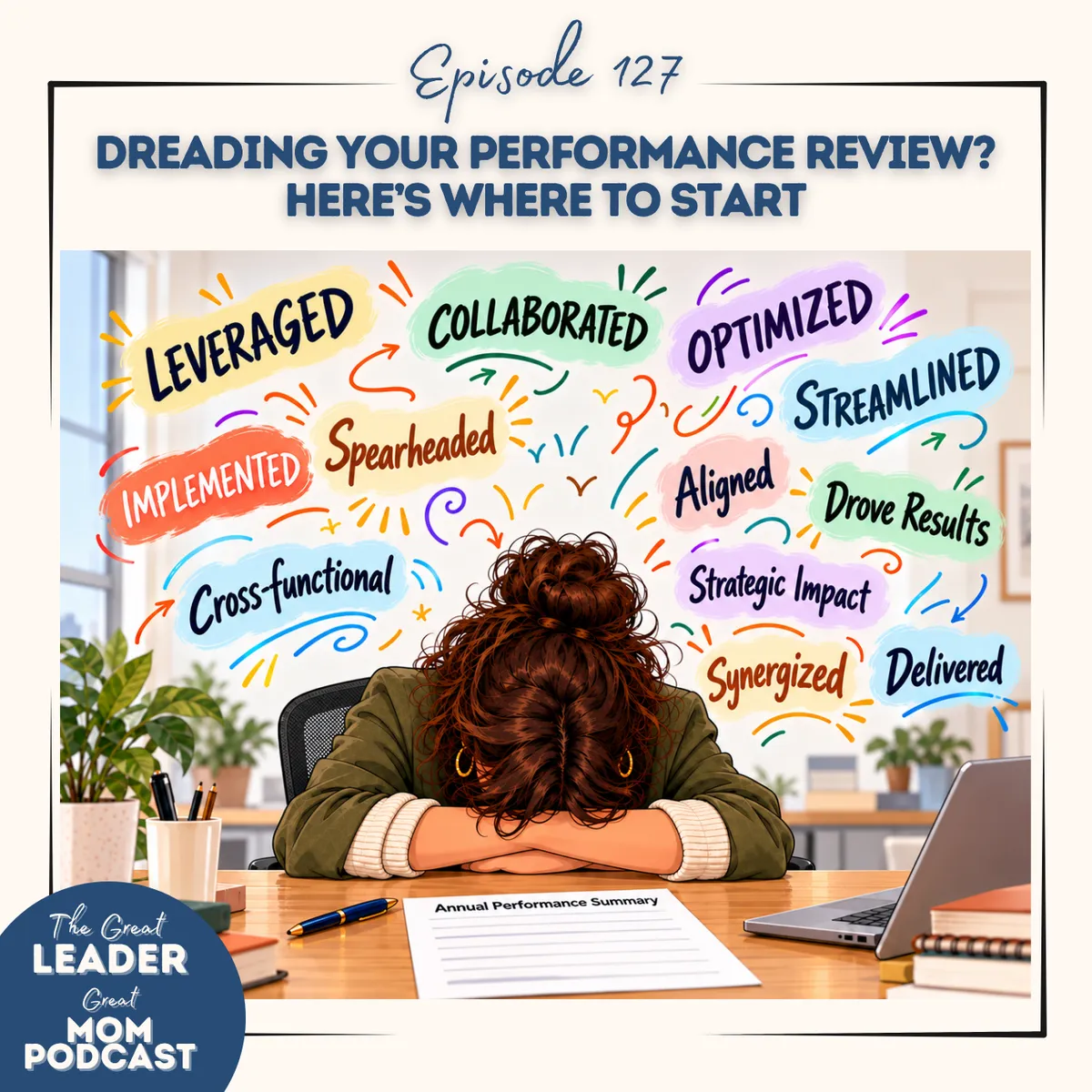
“Ugh. I have to write my performance summary.”
Sign up to book your session: https://lizjolley.com/performance-review
You open the document, stare at the blinking cursor, and suddenly cannot remember anything you did all year. Or you begin typing about how you “leveraged cross-functional relationships” and “optimized stakeholder engagement”—then read it back and wonder what any of it actually means.
In Episode 127 of The Great Leader, Great Mom Podcast, Liz Jolley shares four questions that help you write a stronger year-end performance review self-assessment:
1. What did I actually do?2. So what?3. What made it hard?4. What can I do now that I could not do—or could not do as well—a year ago?
You will learn how to remember the work you completed, show what changed because of your contribution, explain the complexity you navigated, and name the leadership capabilities you can carry into your next project, promotion conversation, job interview, or career decision.
Your performance summary matters, but it is not a final verdict on your value or your career. It is one document that helps tell the story of your year.
Want personalized help? Liz is offering a limited number of free 45-minute Performance Review Writing Sessions. Bring your draft, a rough list, or nothing at all.
Reserve your session: https://lizjolley.com/performance-review
Liz Jolley is the founder of The School of Courage™ and host of The Great Leader, Great Mom Podcast.
Listen to the episode
Prefer Spotify? Listen to this episode on Spotify.
Watch the episode
View full episode transcript
How many of you this week were thinking at your desk, uh, I have to write my performance summary results. I hate this process. Well welcome back my friends. I'm Liz Jolley and I am so glad you are here. Today, I'm gonna show you how to go from the dread of creating your performance review to feeling confident about it, knowing the value you brought to the table.
Maybe you sat down, you opened up a new document, and then you stared at it blankly, watching the cursor flick. And now you can't remember anything you did for the year, and your brain offers these unhelpful thoughts like You just went to meetings forever, all year round. And your poor brain is like skipping a beat and not able to function because you're sitting at your desk thinking, I have no idea what to write, what did I even do?
And you have this desire to jump up and go get a coffee or the urge to clean your desk, which you haven't done in months, and now magically seems like it's the perfect time. This is your brain delaying something that you feel uncomfortable doing. Now, for some of you, you might have gotten your act together, opened a document. And then you start typing things like, I leveraged cross-functional relationships, I optimized stakeholder engagement, I facilitated alignment across multiple work streams. And then you read it back to yourself and you think, oh my god, what does that actually mean?
It's like the corporate buzzword soup just vomited all over your page. We are gonna talk about in this episode four different questions that are gonna help you move from writer's block with to a performance summary that clearly describes what it is you actually accomplished this year And why it matters to you and especially how did it grow you to be a better leader, to be the person who is full of all these cool capabilities?
So before we get to our four questions, what I want to tell you is I'm offering a 45-minute free session on a first-come, first-serve basis For anybody that signs up who wants help bringing your performance review to the next level, this is me and you getting to sit down. I can ask you these questions And you can help build your performance summary probably the fastest you ever have. So if you want that before they're gone, go to the link below and sign up now.
So before we get to our four magical questions, let's start with why performance summaries feel so hard when it comes to doing them for ourselves. Now, if you're like me, I used to love doing this for other people. Everybody on my team, outside my team, I would always offer to do this before it was time for really the submission part. And then when it comes to you, you're like, I have no idea what to say. This is terrible.
I don't even want to write this anymore. It's like your brain works to help everybody else, but it has writer's block when it comes to yourself. And it's funny because our brain gets really snarky a lot of times when we're like, uh well what did I do this year? It's like, well I went to a lot of meetings, I completed my projects, I just did my job. I mean, come on.
And part of the problem here is that we're too close to our own work. We remember the meetings and the revisions and the emails and the difficult people or whatever it is, but we don't see the so what about it. We don't have the perspective to notice what influence, what persistence, what resilience, what leadership skills were required for me to do this job this year. So the other funny thing our brain does is it makes up two unhelpful stories. On one extreme, your brain is like, I don't even need to do this stupid performance summary.
It doesn't even matter because I met with my boss like every week on our one-on-one and they know what I'm doing. So why should I even write this? They already have their opinion of me or my rating already decided. Well, when you really believe that's true, it makes you feel resigned. Like, why does this matter?
And so how are you gonna turn in something and be proud of it when that's your attitude That's just gonna be minimalist submission where you're like, meh, I don't really care. The other extreme of all of this is everything depends on this, which when I even say those words out loud or when you believe this, it feels like immense pressure.
You may be telling yourself, yeah, but it's gonna mean my rating, and that rating is used for 23 different things like my bonus, my promotion, my next job, my future at this company is hinging on this one moment of how I write this performance review. Now before you have a panic attack, take a deep breath, because that's just your brain catastrophizing. Because what you've done is made every single sentence sound enormously important. And so that's where you rewrite the same paragraph six times worrying about your bragging. Am I saying too much about this or what is the perfect word?
And that's when you usually go into Chat GPT, which can kind of help, but we're gonna talk about that in a minute. So in each of these scenarios, you have one where you're completely overthinking your one pager, and then on the other side, you're resigned and you really just don't care. Neither one of these helps you clearly communicate the value of your work, what you brought to the table. Your performance summary does matter And it matters because it's read by leaders who may not know you. They may not see your work firsthand.
Like the way performance reviews work is Everybody gives their supervisor their performance review, and that person often sits around another group of supervisors with the manager. They talk about all of you because they know you personally. And then it goes up and that manager probably knows you even less. And this process keeps going until whatever layer goes to. But we want to make this performance review summary as simple and Easy for someone to look at and see the value you bring to the table.
Now if you're thinking, yeah Liz, but I had Copilot or ChatGPT do this for me. Here's why it may not give you what you actually want. And you can totally use it because Chat GPT and all the LLMs do a great job of summarizing, wording, and helping things you know, be articulated using more Kirpet Buzzword soup. But it doesn't have the context. It doesn't have the what made it hard when you accomplish that one task.
It's only as good as what you give it And so the grammar may be perfect, the language may sound super impressive, but it still may not recognize the work you really contributed here, the value you brought to the table. Because you're the only one that knows what matters to your boss, what matters to the company, what matters to you, that's your authentic role in all of this. So AI can help you polish the words, absolutely. But it cannot automatically know which accomplishments mattered to the ultimate bottom line. What made the work difficult?
What changed because of you being there and contributing? What did you learn about how you contributed throughout the year? You have to uncover that context first, and you do that through these four questions. And then again, AI can be super helpful, but build the context first. So let's get to the first question.
The first question is what did I actually do? This is the tactics. This is we're gonna write about the what. So before you try to polish all this up, just let it be super messy. Go through your calendar, look at your emails.
Look at the meeting notes you have, maybe the documents you opened in the last eight months, what projects were there, problems you solved, difficult conversations, conferences you went to. All the things. Don't try right now to make this list super impressive or head straight to ChatGPT to tell you how to make this more magical Now we need to go to question two. And this is where we ask, so what? Why should anybody care about those results?
What value did you deliver? Like why does it matter? Did it save money? Did it protect production? Did it improve a product?
Did it reduce a risk? Did it make people safer? Did it open up people's time to really spend it on the things that they're way more valuable doing? How did it help leadership make a decision faster and more in line to deliver the results they actually wanted What changed because this work was completed? What would someone care about two or three or four levels up about what you accomplished Maybe you brought the right people together and created a realistic schedule that prevented further delays and dropped the cost.
Now the third question is my favorite, and this is what made it hard? This is my favorite because our brain will be able to answer this and this is where the meat comes in. The stakeholders had different goals and they were all pulling in a different direction. And that's what made the conversation difficult and that's why we had to do XYZ Or the team was already behind schedule and there was so much emotion about making anything that would potentially bump the schedule. The context really matters.
You identifying the barriers that stand in the way makes such a difference to building more color to why this matters and why no one else could do it. The obstacles that we face throughout the year reveal the most valuable part of your contribution, and we often don't communicate these at all. So question number four, who did I become through all of this? So what can I do today that I wasn't able to do a year ago? What are the skills that I now have that I definitely didn't know before this year started?
Did you learn how to have a difficult conversation without avoiding it? Did you learn how to really frame a problem so that a team could be aligned when they had very competing priorities? Did you learn how to see important nuances and contracts from a technical perspective that you would have never thought about before? Did you navigate a major schedule delay without losing the team's engagement? These are leadership capabilities.
You did not only complete the work and deliver the task, you increased your ability to lead the work, to influence other people, to make tough decisions, to navigate complexity, to develop talent to do the hard thing. Those capabilities you bring along into whatever you do next, into this same job with new projects, into a different job, into a promotion discussion about why you deserve the next raise into a job interview, whether it's internal or external, being able to talk about the leadership competencies, the leadership capabilities that you've built with an associated actual example. is phenomenal.
Chat GPT can't necessarily give you that. You have to answer these questions first. So when we put all the four questions together , We're going to take one accomplishment, work it through all four of these questions. What did I do? Why did it matter?
The so what? What made it hard? What did I learn about me? And how did I develop as a leader in all of this? Now you're no longer writing, I facilitated cross-functional stakeholder alignment, and instead you're describing the actual situation.
You brought together stakeholders with competing priorities. You helped them understand the trade-offs and make a decision that kept the project moving along in the process. Maybe you strengthened your ability to navigate disagreement. Or ask better questions or influence without having direct authority over people. And that sounds like you because it came from you what you actually did, who you actually are.
Now your performance summary Is gonna go to your boss and they're gonna have their own opinions about it. You may be really proud of it after all of this, but your boss may look at it and see the opposite. They may tell a separate story that's very different than yours. If you really believe in the value you contributed this year, then what they think honestly matters very little because their value system is different. So their opinion doesn't erase the value of what you accomplished or the person you're becoming or the leadership skills you built.
It's just a document at this point in time. And the more you, though, believe in the value you contribute, deep down, then the more you can stay grounded when the people around you question what you did. The more around you that what used to trigger you won't trigger you anymore. Truly. This is the work that helps build your self-confidence, your self-agency.
The knowledge of who you are and what you bring to the table, despite whatever job you're in or whatever boss you have. If you want this free 45 minute session, go to the link below and sign up soon because they're gonna be gone, I promise, and it's gonna be too late. Why would you not make your performance summary even easier this year and get one-on-one help?


